EMQ » April–June 2020 » Volume 56 Issue 2
By Frank Preston
This article discusses issues that impact scripture engagement in some Disciple Making Movements (DMMs) among Muslims.
There are many nuanced definitions of scripture engagement, ranging from incidents of consumption (i.e. number of times a person reads the Bible per week) to cognitive recall. Bettina Gottschlich defines scripture engagement in her dissertation as: Effective Scripture engagement is seen in changed intentions, attitudes and resultant behavior of a person who “pleases God and man” based on a sincere conversion (Gottschlich, 2013). Her definition provides a level of observational measurement that is helpful for this research. Though intentions and attitudes are less observable than behavior, Fishbein’s research on planned behavior notes that intentions and attitudes are correlated with behavior (Fishbein & Ajzen, 1975). Behavior, especially repeated behavior, can reflect a change in intentions and attitudes.
Case Study: Disciple Making Movement Where Scripture Engagement is Observable
Pulau is located in Asia and has one of the highest concentrations of Muslim populations in the world with at least 175 Unreached People Groups and seventy-five Unengaged People Groups. The Focus on the Fruit (FoF) movement was reviewed by the author in February 2014. At the time the group was about 7,500 Muslim background believers in three streams, generally located within one unreached people group. Currently FoF has documented an excess of 12,944 churches comprising of five or more Muslim background believers per church with twenty-five local activist (apostles) reaching into forty Muslim Unreached People Groups in twelve countries. The leadership structure has three key local leaders and about fifteen stream leaders.
A few core principles guide this movement:
- Scripture centric and not leader centric. A national leader noted: “It is key to shift the focus from the teacher to group members discovering truth from God’s Word for themselves. We help people discover directly from the Bible first via an oral transformation dialogue series, then by reading and discussing the Bible with others using the Seven Question Model.” (Fruit, 2018).
- Scripture centric in matching personal needs to scriptural solutions. In the Quad coaching process noted below, the coaches develop Discovery Bible Studies that relate to issues that inhibit spiritual growth of their constituents (Fruit, 2018).
- Focus on groups not individuals in the outreach process. One leader notes, “Making disciples in groups rather than just individuals greatly increases spiritual fruit multiplication. Locals on a spiritual journey need their natural groupings to become their support groups” (Fruit, 2018).
- Outreach is group oriented with greenhouses as the mode of scripture engagement. Greenhouses are outreach and discipling activities within their own small social groupings where local seekers read scriptures and discuss the text using the seven questions format.
- Group leaders are coached to effectiveness. Effectiveness is a measurement that is both qualitative and quantitative. Qualitative is based on character of the leader and is observed by Quad teams that function at each level of leadership. Training modules are then developed from the observations. Quantitative measurement is determined from groups that are multiplying generationally and leaders that are being developed at each generational level. Both formal and informal trainings are considered in quantitative measurements. Training should yield scripture engagement, demonstrating character development and reproduction of believers in the church.
- Coach Team generally consists of four roles to create a Quad Team: (1) Facilitator (2) Spiritual teacher (theologian) (3) Management and (4) Family coach, also called member care. A Quad Coach team functions at each level: Clusters (seven to ten linked small groups in three generations), Mini Regions (four to ten clusters), Regions (four to ten Regions) and Streams. These classifications are somewhat fluid as FoF applies a Jethro principle from Exodus 18 to link leaders from different levels. The goal is to have peers who are in the Quad coach teams and to move away from leader centric and toward word centric spiritual dependency.
- Roving coaches cut across levels to provide specialty functions such as family counseling and financial, assistance something akin to an alms role to help out those with needs. These too can help emerging leaders grow in their faith.
In an interview of the main national leaders of the FoF movement in 2018, I asked what the key indicators were to show that scripture engagement was occurring within the movement. This question was critical since the movement was both broad and complex, involving some 13,000 churches and in excess of 50,000 Muslim background believers, and was expanding in excess of fifty percent per year. One leader explained that he observes the data set for each quarter and determines if at each level of leadership, a Quad team exists. Then he looks at the quantity of formal and informal trainings that are occurring. If he sees that these two indicators are functioning, he feels assured that scripture engagement is occurring at all levels.
Though stated principles can be instructive, this research wanted to validate outcomes. To accomplish this, the research obtained four quarters of data from one calendar year on the 12,944 churches and 1,629 discovery groups comprised of mainly seekers. At the time of the analysis, there were 5,734 local leaders and 3,216 local leaders in training. FoF classifies a church as having over 50% of the participants being confessed believers. Generally, the number of believers becomes 100% over time, especially as it reproduces generationally, and members are baptized. The mean of generations was between fourthgeneration with 2,775 churches and fifth generation churches at 2,595.
Observing 2015 data, FoF had 7,226 churches and 1,122 Discovery Bible Studies. Hence, church growth from 2015 to 2016 was 76%. Local leaders increased from 4,050 in 2015 to 5,734 in 2016, a 42% increase. Candidate leaders increased from 2,329 in 2015 to 3,216 in 2016, a 38% increase.
Correlations of the key variables are in Table 1.
Table 1. Training Correlations
| Informal Training | Formal Training | |
| Seekers / Discovery Bible Study | 0.60 | 0.64 |
| Group / Church | 0.82 | 0.76 |
| Candidate Local Leader | 0.89 | 0.79 |
| Local Leader | 0.79 | 0.74 |
Note: Correlation is significant at the 0.01 level (2-tailed) using Pearson’s Correlation Coefficient method.
Using training as the behavioral variable (training occurred because the Quad team observed character or skills that were needed and then arranged a DBS-based training), seeker groups were correlated 0.60 for informal training and 0.64 for formal training and both were statistically significant. Training and group were correlated 0.82 and 0.76 for informal and formal respectively. Candidate local leader was 0.89 and 0.79 for informal and formal training respectively and Local Leaders were 0.79 and 0.74 for informal and formal training.
What the correlations are saying is that training based on Quad Team observations resulted in group health and leadership development. Since training is tethered to scripture centric solutions (Discovery Bible Studies), one can ascertain that scripture engagement had a measurable correlation that was statistically verified.
Literature Review
Scripture engagement is a contested term, ranging from incidents of consumption to cognitive recall. Fergus MacDonald, former General Secretary of the United Bible Societies, refers to scripture engagement as ways that Christian leaders and communities “help people interact with the Bible as the Word of God” (Crockett, 2005). Crockett argues that the term “scripture engagement” refers to the “acquisition, development, or performance of abilities that facilitate or help other people interact with the Bible as the Word of God” (Crockett, 2005). Scripture engagement scholar Wayne Dye discusses eight conditions by which scripture engagement can be effective (Dye, 2009a). These conditions relate to the input side of a systems approach, but the process side is not discussed. The assumption is that if you have the right input, a desired output will normally follow. Other scholars argue for improved inputs such as digital Bibles (Cho & Campbell, 2015; Hutchings, 2017), orality (Margetts, 2013; O’Donnell, 2013; Ong, 2002), translations (Dye, 2009b; Federwitz, 2008; Margetts, 2013; O’Donnell, 2013), and removing copyright restrictions (DeVoss & Rife, 2015; Elkink & Seminary, 2013; Jore, 2013). Though these are important and informative, scholars rarely discuss the process side of the equations. The general consensus is that better inputs will lead to an output of scripture engagement, yet this has not yielded consistent results, as the International Mission Board and Gottschlich studies bear out (Global Research Division of the International Mission Board, 2017; Gottschlich, 2013)
Gottschlich (Gottschlich, 2013) observes in her research that even though the scripture engagement inputs were available, there were places where the population being studied did not have scripture engagement that included changed intentions, attitudes and resultant behavior of a person. She noted hindrances in distribution and weak leadership were possible culprits. The International Mission Board in their study of movements in Africa (Global Research Division of the International Mission Board, 2017) noted that under similar conditions, one group demonstrated scripture engagement and the other group showed significant lack of understanding of the scriptures. In one group, it appeared that the interviewees deferred to the pastor whereas another group deferred to the scripture itself. The difference between the two groups appeared to be that in the first group, the leader was centric to the understanding of the scripture, but in the second group the scripture was centric.
Micro-Meso-Macro Model
This research has been embracing a systems approach in observing the issue of scripture engagement. A simple system has an input, a process and an output. The literature on scripture engagement has been overwhelmingly biased toward inputs as a determinate of a successful output in scripture engagement. But it is necessary to observe the environment of observations. Environment involves three levels of abstraction (1) the individual level, also called the micro level (2) the community or group level, also called meso level and (3) the national/organizational/corporate level, also called macro level.
In literature on organizational research theory, especially in areas involving multilevel theory, considerations are given micro-meso-macro levels of abstraction (Klein & Kozlowski, 2000; Rousseau, 1985). A person’s behavior is often mediated or moderated by their immediate community. Communities are likewise mediated or moderated by national, organizational or corporate structures. Rarely does an individual influence macro levels, but macro strongly influences the individual level. Governments impose taxes and regulations that impact individual and community lives. Meso/communities become bodies of individuals that either adopt macro influence or resist it. Individuals within communities can influence community decisions in positive or negative ways.
Figure 1 shows a model for this interaction related to the issue of scripture engagement.
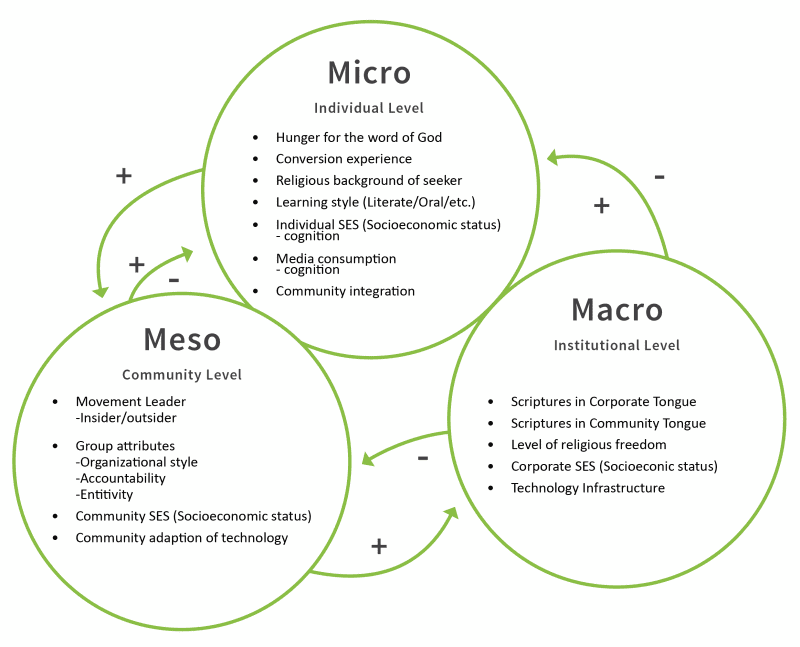
Note that at the individual level two-way interaction occurs only with the community, but the individual and community are impacted by macro dictates. Not all dictates are bad for the individual. For example, macro has the capacity to conduct a translation of the scripture or develop an app that aids in scripture engagement. But the implementation of innovations generally involves the community level in diffusion to the individual level. People learn of some products such as a Bible app from friends, mentors or religious leaders, and trust from community level confers trust to individuals that the item has credence.
Scholars’ critique of the macro level is that they generally do not engage the meso level as partners in program development (Unwin, 2017). It is not uncommon for macro organizations to develop a health campaign funded by institutions, and then engage the meso level to administer the products or programs to individuals. No doubt the macro’s intentions were good and the help to the individuals was necessary, but the lack of engagement at the meso level often supplanted a support system that is crucial to the community fabric.
When institutions develop a product or project, they may consult with meso/community level leaders, but often they don’t truly partner with them (Van Riezen, 2015). Partnership involves power, discourse, interdependence, and functionality where collaborators find equilibrium in the exchange (Morse & McNamara, 2006). When organizations make unilateral interventions, they may win a battle but lose the war by bypassing meso-level leadership engagement.
Macro proponents for scripture engagement could argue that community could be developed after a product is released. The early church in Acts could be seen as an example of new communities that arose from the context of Greek unbelievers. A confounding factor to this logic is that of the twenty-one conversion experiences in the Book of Acts, nineteen were in groups. The exceptions were Paul and the Ethiopian eunuch. Hence some community preexisted before conversion, and the first converts knew each other and already experienced collective identity.
When macro organizations are considering scriptural engagement at the individual level, community or meso-level structures need to be a strong consideration. Implementation of a project should be within the community and by the community. This requires more work by macro organizations in the beginning but lays a foundation of sustainability.
Summary
This study did not try to investigate all the locations where disciple-making movements were occurring and to determine if scripture engagement was happening in those locations. Constructs such as “What is a disciple-making movement?” lack agreement. “What is scripture engagement?” is likewise a contested construct. Even so, without those definitions, this research generally observes that the lack of scripture engagement appears to be determined at the meso level. Macro organizations are developing a plethora of products and options to resolve a micro-level problem of scripture engagement, but it appears that in the places where scripture engagement is occurring, it is often associated with meso-level leaders who have developed ways to support scripture engagement for their constituents. In places where scripture engagement was not happening, it appeared that macro and/or meso involvement hindered micro engagements with the scriptures.
In some places there was hindrance of distribution, but often engagement was hindered because of the lack of development of meso leadership. In some places local (meso) leadership sought to teach in a way that was appropriate for the meso leader but was not helpful to these constituents for the long term. In others, the meso leader had constituents discover the scriptures, and these constituents were taught by passages they considered.
It is unlikely that leaders are “weak” as stated by Gottschlich (Gottschlich, 2013), but that their modeling and training may have encouraged them to teach instead of helping believers to become scripture centric via something like a discovery process. Even when it is apparent that pastors are discussing a Discovery Bible Study method, they are actually teaching; hence their disciples were becoming leader dependent.
Additionally, when meso leaders are empowered, they appear to find solutions at the local level to address scripture engagement for their constituents. Wesley did the same by offering three kinds of groups within a single context to address stages of spiritual growth, literacy, and class.
No doubt there are movements where no local language scripture exists, or alternatively where the lack of literacy makes mass consumption of scripture impossible. How can these be addressed? This is a challenge, but research appears to point to solutions having meso-level leaders find temporary solutions and build capacity to address the issue. Macro organizations can be of help when there is a partnership with meso participants.
Frank Preston and his wife Linda have served with Pioneers for over twenty-five years tasked with developing media strategies to reach Muslims and part of the media2DMM movement. Frank earned his PhD from the School of Journalism and Mass Communication at the University of Wisconsin-Madison. His research interest is in the confluence of media and cell group formation in the recruitment and training of participants in radical Islamic movement.
References
Cho, K. J., & Campbell, H. A. (2015). Religious use of mobile phones Encyclopedia of Mobile Phone Behavior (pp. 308–321): IGI Global.
Crockett, J. (2005). Engaging Scripture in Everyday Situations: An Interactive Perspective that Examines Psychological and Social Processes of Individuals as They Engage Scripture Texts. Black Theology, 3(1), 97–117.
DeVoss, D. N., & Rife, M. C. (2015). Cultures of copyright: Peter Lang.
Dye, T. W. (2009a). The Eight Conditions of Scripture Engagement: Social and Cultural Factors Necessary for Vernacular Bible Translation to Achieve Maximum Effect. International Journal of Frontier Missiology, 26(2), 89–98.
Dye, T. W. (2009b). Scripture in an Accessible Form: The Most Common Avenue to Increased Scripture Engagement. International Journal of Frontier Missiology, 26(3), 123–128.
Elkink, T., & Seminary, B. (2013). A CHRISTIAN RESPONSE TO COPYRIGHT.
Federwitz, D. M. (2008). Local Ownership in a Language Development Program: Will It Lead to Sustainable Use of Scripture. Language Development, GIAL, Dallas, TX.
Fernando, A. (2007). Jesus driven ministry: Crossway.
Fishbein, M., & Ajzen, I. (1975). Belief, attitude, intention and behavior: an introduction to theory and research. Reading, Mass: Addison-Wesley Publishing Company.
Fruit, F. o. t. (2018). Book 2: Learn from Fruitful Practitioners (Vol. 2): Focus on the Fruit
Global Research Division of the International Mission Board, N. H. M., and Cityteam Ministries (2017). Engagement Assessment of the Susu, Vai, Koranko,Yalunka, Krim, Fula, Mandingo, Sherbro, and Northern Kissi of Sierra Leone. Retrieved from
Gottschlich, B. (2013). Transformational Scripture Engagement Among the Budu of Congo-Kinshasa: Fuller Theological Seminary, School of Intercultural Studies.
Hutchings, T. (2017). Design and the digital Bible: persuasive technology and religious reading. Journal of Contemporary Religion, 32(2), 205–219.
IIsaac, E. (1964). Historical Atlas of Religion in America: JSTOR.
Jore, T. (2013). The Christian Commons. Minneapolis: Distant Shores Media.
Klein, K. J., & Kozlowski, S. W. (2000). From micro to meso: Critical steps in conceptualizing and conducting multilevel research. Organizational research methods, 3(3), 211–236.
Margetts, R. (2013). From Scripture Access to Scripture Engagement. (Master of Arts Mixed Methods), All Nations, Hertfordshire, England.
Meadows, D., & Wright, D. (2008). Thinking in systems: Chelsea Green Publishing.
Morse, S., & McNamara, N. (2006). Analysing institutional partnerships in development: A contract between equals or a loaded process? Progress in Development Studies, 6(4), 321–336.
O’Donnell, K. (2013). Umuhimu wa Biblia: An investigation into how Tanzanian Christians perceive and engage with God’s Word. (Master of Arts Mixed methods), Redcliffe College Gloucester, England.
Ong, W. J. (2002). Orality and literacy: Routledge.
Rousseau, D. M. (1985). Issues of level in organizational research: Multi-level and cross-level perspectives. Research in organizational behavior, 7(1), 1–37.
Unwin, T. (2017). Reclaiming information and communication technologies for development: Oxford University Press.
Van Riezen, K. (2015). Partnering Towards Sustainable Movements for Scripture Engagement and Language Development. Biola University.