EMQ » April–June 2019 » Volume 55 Issue 3
By Alan B. Howell and Arie De Kruiijf
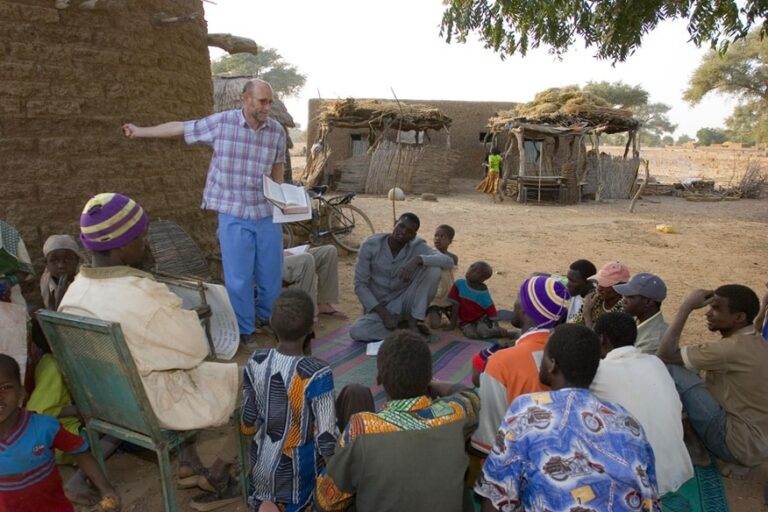
A small group working in partnership with the Leprosy Mission gathered to discuss an important question. How can we connect people in this context, especially those with leprosy, to the biblical story? People here communicate primarily orally – through spoken words. They also practice a form of “folk” Islam which combines Islamic and traditional religious practices.
We agreed that Chronological Bible Storytelling was the best place to begin. We knew that creating audio recordings would also be useful. But how can we use these forms to create a program that effectively connects people from an oral culture with Christ?
This question is not unique to northern Mozambique. Tom Steffen says that, “illiterate and semi-literate people in the world probably outnumber those who can read. And people with such backgrounds tend to express themselves through more concrete forms (story and symbol) than abstract concepts (prepositional thinking and philosophy).”[i] In mission circles, recognizing the impact of orality has created a deeper appreciation for storytelling as an effective means for sharing the Gospel.[ii] Graham, for example, believes that “worldview transformation requires story-tellers who grasp the whole biblical story and can meaningfully communicate it among a people.”[iii] In the process of developing story-tellers he realized that, “knowing the story did not necessarily make them good story-tellers. They had to practice telling the story” as well as understand their audience “to effectively communicate the biblical story.”[iv] Graham suggests that the church focus on multiplying “story-tellers who understand the whole story.”[v]
While developing individual story-tellers is certainly a good and useful strategy, the Gospel of John reminds us that conversations are another mode of oral communication that can facilitate transformation. After briefly exploring Jesus’ conversational approach we will share our experience of using recorded conversations about core Bible stories among the predominantly folk-Islamic Makua-Metto people of Mozambique.
Conversion and Conversation in the Gospel of John
In the Synoptic Gospels (Matthew, Mark and Luke), conversions seem to happen mostly in the context of miraculous signs and storytelling (parables). But the book of John offers us a different perspective. In that Gospel, conversion happens in the context of large signs and life-giving conversations that all point to the resurrected lamb who fully reveals God’s love. Eugene Peterson frames it this way,
“in the quartet of gospel writers, John gets the final storytelling word. John writes his Jesus story in quite a different way than his canonical companions… who all follow the same basic outline… John primarily tells stories. But as Jesus speaks, his words flourish into conversations and discourses with all sorts and conditions of people, conversations brief and lengthy, conversations pithy and elaborate, but always conversations. Several times the conversations develop into discourses, but the conversational tone is always maintained.”[vi]
John presents Jesus as the Logos, the conversational word of God,[vii] made flesh (1:14). His first miracle stems from a conversation with his mother (chap. 2). And that dialogical pattern continues with a wide variety of people. There are those who are receptive (like some of the disciples in 1:35-42); those who are reluctant or resistant (Nathanial in 1:43-51); people in need of rescuing (the adulterous woman in chapter 8) and even people who resolutely want to reject him (the Jews in chapters 5, 8, and 10). He has tough conversations with Mary and Martha about his absence at their brother Lazarus’ death where he takes very different approaches to each sister depending on their own personalities (chapter 11). And maybe most importantly, the disciples’ conversion experience, their confession of Jesus as the Christ, happens in the context of a conversation (6:69).
For the purposes of this article, though, we will briefly highlight two sets of “Conversion Conversations”:
1. Nicodemus and the Samaritan woman
In chapter 3, Jesus receives Nicodemus, a respected religious leader, who appears suddenly one night to converse with Jesus. They discuss belief and eternal life and talk about the need to be born of water and spirit. Nicodemus seems to misunderstand nearly everything Jesus says and leaves this conversation feeling more confused than converted.
Then, in chapter 4, during the heat of the day, Jesus converses with a Samaritan woman with a scandalous backstory. She tries to trap Jesus in a religious discussion about the proper place of worship, but quickly recognizes Jesus as the source of living water.[viii] By sharing the story of her encounter, she succeeds in bringing her whole village to Jesus to converse with him directly.[ix]
Examining these conversations together, it is surprising that the Samaritan woman’s faith grows quickly while Nicodemus’ seems to die on the vine. But, if we are patient with this religious leader and follow his story through the rest of the Gospel, we can see how his faith builds behind the scenes until he publicly questions the actions of the Jewish leaders against Jesus (7:45-52) and eventually aligns with Jesus by asking to bury his body when all the disciples have abandoned their teacher (19:38-42). Both Nicodemus and the Samaritan woman are converted through their conversations with Jesus, but John reminds us that their faith journeys each had different timetables.
2. The Lame Man and the Blind Man
The stories of both the lame man and the blind man have many similarities. Both include short personal histories (5:5 and 9:1) before Jesus takes the initiative to heal on a Sabbath (5:6, 9 and 9:6, 14), then the men are challenged by the religious leaders about the source of their healing but don’t know where Jesus is (5:12, 13 and 9:12, 15), until finally Jesus finds them and invites them to believe (5:14 and 9:35). This is the part where their “conversion” stories diverge. While the lame man’s faith dies abruptly as the result of pressure or persecution (even tattling on Jesus to the religious leaders – 5:15), in the blind man’s conversion story, the challenges act as catalysts for his faith to grow. Interestingly, their conversion stories seem less connected to their conversations with Jesus and more connected with the impact of their conversation about Jesus with others.
Throughout the Gospel of John, Jesus can be overheard conversing with people who are resistant, reluctant, receptive, as well as those who flatly reject him as Lord. His engagement with these characters highlights the connection between conversation and conversion. Those same types of people can be found in the world in general and in our context of Mozambique more specifically. John’s Gospel witnesses to the power of conversation in shaping a faith journey.
In the next section, we turn our attention to describing the way we used conversation as a way to communicate biblical stories among the Makua-Metto people.
Chronological Bible Storying through Conversations in Mozambique
Our approach was to follow the meta-structure of Chronological Bible Storying[x] but to allow each story to be told in a dialogical, or dialogue-based, format. We created a list of fifty core stories that included narratives of people with leprosy (2 Kings 5; 2 Kings 7:3-20; and Luke 17:10-18), and also encouraged the conversation participants to make those presentations sensitive to Muslim hearers. For the first round of recordings we provided two conversation guides to help participants understand how the process would go. After that, local pastors and church leaders prepared and organized a conversation about each biblical story. If the scriptures for that section had not been translated yet, members of the Bible Translation team would work on a provisional copy of the text to be read as part of the recorded conversation.
One advantage of this dialogical technique was that it allowed the weight of the biblical storying approach to be a communal process. Walking through the story collectively in conversation involves less risk than one person having to get the story exactly right alone. As it is a conversation (group) and not just a person listening (attending) on his/her own, this widens the scope of potential impact and can stimulate deeper levels of social change and innovation.[xi] We tried to use only one Bible text in each recorded conversation and only referred to stories as part of the group discussion if they had already been covered in previous recordings.
Another advantage we noticed is that the dialogical approach models a communal hermeneutic. The conversation teams connected the biblical stories to application in a comfortable, natural way. Modeling the application of the story in the context of conversation is important for equipping and training people to use dialogue as an orality strategy. Brown notes that, “oral communicators learn how to do things, not so much by formal study or how-to-do-it manuals, but by observation and mimicry.”[xii] So, each of the recordings modeled not only a method of storytelling, but also modeled an obedience oriented hermeneutic that demonstrated the process of communal exploration in order to find appropriate applications.[xiii]
One surprising observation was that the conversation group spent much more time than we expected in the initial greetings at the beginning of each recording. While Western-style recordings might “get down to business” and jump right in to the topic at hand, conversational patterns among the Makua-Metto do not. Conversation is to be enjoyed and if you have something worth saying then you need to establish connection and trust with a long time of greeting. Greetings are vital for participants to believe that they can trust this person to share what is important and true. From anecdotal observation of people listening in groups, we were pleased and surprised that the long introductions served to build credibility.
Conversation provides means of verifying information, is a natural setting for disbanding false information or false beliefs, promotes ownership and empowerment by not assuming that trained ‘clergy’ have a monopoly on knowledge or the only right to speak, has greater potential for social inclusion (giving opportunity for marginalized voices like people with leprosy or women), provides space for addressing taboos. “Oral communicators tend to communicate in groups, and they learn through interacting with other people. They cannot think about something for very long without discussing it with others… In a survey conducted by Trans World Radio, they found that their most popular radio programs were those which included drama and dialogue, rather than one voice speaking for a long time.”[xiv] While re-enacting a drama may not be easily produced on recordings, everyday elements of conversation certainly are.
Example Conversation Guide
Text: Genesis 22:1–19
Theme: Abraham Offers Isaac as a Sacrifice
Time: 20 minutes
- Facilitator greets and is greeted by conversation participants. One woman says she is doing well, but she’s having problems with her neighbor who always wants to borrow their new radio.
- Facilitator summarizes what we learned from the previous story regarding Abraham:
- Abraham is an important person to people of different religions.
- God called Abraham to leave his clan and go to a new land.
- Even though Abraham was old and childless, God promised to bless Abraham with many children – turning him into a great nation and promising to bless the rest of the world through Abraham’s family.
- Facilitator connects the woman’s personal story to today’s biblical story and reads Gen. 22:1-19.
- Conversation: Participants take turns sharing what they learned, relating the following points:
- God gave Abraham and his wife Sarah a son in their old age.
- God asked Abraham to sacrifice his son as a burnt offering up on a mountain.
- Abraham ties up Isaac and puts him on the altar, is ready to kill him, when a voice from heaven tells him to stop.
- The angel says that now God knows Abraham loves him with his whole heart, because he is not withholding even this beloved child from God.
- The angel points out a ram stuck in the bushes nearby and Abraham and Isaac offer it as a sacrifice.
- God says he is pleased with Abraham and again promises to bless him.
- Facilitator asks the participants: “So, what did you think of this story? What does it mean for us today?”
- One man replies that he was amazed at the way Abraham trusted God, but wonders why God would ask someone to do that.
- Facilitator admits that this is a strange and difficult story and explains that, of course, most people know (though some still don’t!) it is wrong to kill children, but back then many of the gods or evil spirits that people worshipped would tell them to offer their children as sacrifices in order to gain a blessing. So, God tests Abraham’s faith, but importantly Isaac is spared because a substitute is found.
- The woman replies that she was surprised to hear how openhanded Abraham was with God. Most people she knows, (laughing) herself included, struggle with being tightfisted with the blessings that God has given (selfish). But Abraham kept his hands open, knowing that God could take the blessing away, too.
- Another responds by saying that yes, it’s true Abraham’s openhandedness means God could have taken the blessing away, but it also means that Abraham’s hands were open to receive more blessings from God – so many blessings that his family would be able to bless the whole world! That is amazing and requires much faith – that’s why many people refer to Abraham as the ‘Father of Faith.’
- Woman says that this story is challenging her to not be selfish with what she has and to be openhanded with God and have faith in His goodness just like Abraham did.
- Participants say goodbye and encourage each other to share what they have learned with others.
Conclusion
The Leprosy Mission’s primary objective with this program was to find a practical way to expose people affected by leprosy to Scripture and the Gospel. The second objective was to raise awareness of leprosy and address issues of stigma and discrimination that are still prevalent in the community and possibly also among the church. People affected by leprosy regularly gather together in small community groups to practice and teach self-care principles to prevent physical complications due to leprosy. Solar powered MP3 players were given to group leaders to play the Bible stories during these meetings. SD cards were also used to share these recordings with church leaders to spread these conversations and raise awareness of leprosy and stimulate the debate around stigma and discrimination that is often still present in society. This open format allowed for easy sharing of the recordings with even those outside the leprosy groups or the church for listening on cell phones or MP3 players.
“Oral strategies are an essential part of bringing about gospel movements” in many parts of the world today.[xv] Steffen notes that, “The orality movement is a work in progress, and must remain so if the disciple-making process is to improve in its journey cross-culturally at home and abroad… We can expect other new research to emerge in the near future that will influence and mature this orality movement. Yes, there is more to the story.”[xvi] From our reading of the Gospel of John and experience in this process, we believe that orality in a dialogical format reveals a deep connection between conversation and conversion that the church should use to further the Kingdom of God.
Alan Howell, his wife Rachel, and their three girls live in Cabo Delgado, Mozambique. Alan is a graduate of Harding School of Theology. The Howells have lived in Mozambique since 2003 and are part of a team serving among the Makua-Metto people.
Arie and Marié de Kruijff have been working with the Leprosy Mission in the Cabo Delgado province since 2004. Arie comes from a medical background and the Leprosy Mission has been assisting the local Health Department to implement the leprosy control program which is very community based.
[i] Tom A. Steffen, “Why Communicate the Gospel through Stories?” Perspectives on the World Christian Movement, 4th ed. (2009): 441.
[ii] For more see Tom A. Steffen, “Orality Comes of Age: The Maturation of a Movement,” International Journal of Frontier Missiology 31, no. 3 (Fall 2014): 139-147. Also, for a summary of Chronological Bible Storying with a helpful of analysis of its efficiency versus its sufficiency, see Cameron D. Armstrong, “The Efficiency of Storying,” EMQ 49, no. 2 (July 2013): 322-326.
[iii] D. Bruce Graham, “Transforming Worldviews through the Biblical Story.” Perspectives on the World Christian Movement, 4th ed. (2009): 442.
[iv] Ibid., 443.
[v] Ibid. For examples of how individual storytellers were trained see, Avery Willis and Steve Evans, Making Disciples of Oral Learners (International Orality Network, 2005), 46-47. See also Paul F. Koehler, Telling God’s Stories with Power: Biblical Storytelling in Oral Cultures, (Pasadena, CA: William Carey Library, 2010).
[vi] Eugene H. Peterson, As Kingfishers Catch Fire (London: Hodder & Stoughton, 2017), 321-2.
[vii] In John’s Gospel, Jesus is the “locus of God’s presence on earth, through whom all divine communication comes and goes.” Ben Witherington III, John’s Wisdom: A Commentary on the Fourth Gospel (Louisville, KY: Westminster John Knox Press, 1995), 120.
[viii] Her thirst satisfied, she leaves her bucket behind (4:28).
[ix] In the following conversation with the disciples it is clear that they are spiritually less perceptive than the Samaritan woman was!
[x] For more on why Chronological Storying matters see International Orality Network, “Making Disciples of Oral Learners” Perspectives on the World Christian Movement, 4th ed. (2009): 438. For more on different types of stories for evangelism and discipleship, see Kelly Malone, “The Power of Biblical Storytelling,” EMQ 50, no. 4 (July 2014): 314-320.
[xi] For more on the power of connectedness and conversation for the process of social innovation see C. Otto Scharmer, Theory U: Leading from the Future as It Emerges (San Francisco, CA: Berrett-Koehler Publishers, 2009).
[xii] Rick Brown, “Communicating God’s Message in an Oral Culture,” International Journal of Frontier Missions 21, no. 3 (Fall 2004), 125.
[xiii] Or as Weaver puts it, this method models “promoting informed discussions among listeners.” For more on reaching oral cultures see, Ed Weaver, “Orality is Just Good Missiology,” EMQ 51, no. 2 (April 2015): 220-224.
[xiv] Brown, 125-6.
[xv] International Orality Network, “Making Disciples of Oral Learners” Perspectives on the World Christian Movement, 4th ed. (2009): 439.
[xvi] Steffen, “Orality Comes of Age: The Maturation of a Movement,” 146.