EMQ » April–June 2019 » Volume 55 Issue 2
By Brian Stiller
In 1960 globally there were 90 million Evangelicals. Today estimates are that there are more than 600 million. I wanted to know why.
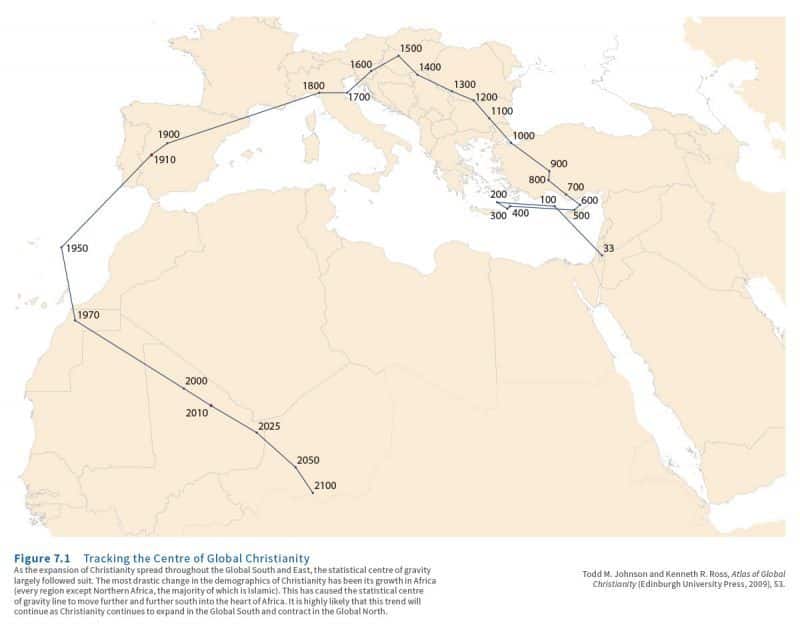
Two thousand years ago the Christian church began on the day of Pentecost in the city of Jerusalem. Since then the demographic “center” of Christian populations has made its way across Europe.[1] With the surprising growth of the Christian community globally in the past fifty years, the demographic weight of Christianity in Africa and Asia has pulled this global center south and west. Demographers now place the center of population density of Christians in Africa.
The metaphorical center of world Christianity has literally moved from Jerusalem to Timbuktu in the nation of Mali. This is not merely some clever observation—it is a remarkable sign that points out what we otherwise might miss. Long a city name used as a metaphor for a far-away and unreachable place, today Timbuktu signifies this massive shift, as the location of the center represents a mighty upsurge in Christian faith around the shrinking globe.
What is the extent of that growth? The answer might come as something of a surprise, particularly to those in the West. Even those least inclined to dismiss religion from ideological modernist presumptions—the Lutheran sociologist Peter Berger, for example—during the 1960s fell into the trap of assuming that the trends in former State-Church Western European nations (such as France and Sweden) were part and parcel of modernization. In 1968, Berger projected that “[By] the twenty-first century, religious believers are likely to be found only in small sects, huddled together to resist a worldwide secular culture”[2] typified by the fragmentation of life and the division of labor. Thirty years later, however, these projections seemed far less plausible. As Peter Berger now notes:
The assumption that we live in a secularized world is false. The world today … is as furiously religious as it ever was, and in some places more so than ever. This means that a whole body of literature by historians and social scientists loosely labeled “secularization theory” is essentially mistaken.[3]
The journey from Jerusalem to Timbuktu, with its relocation of the Christian center out of its centuries-long European habitat, alerts us that much is going on. As we will see, this growth and relocation is not driven merely by external forces, but also by re-expressions of faith in five major ways. These reasons, or drivers, expand the witness of the gospel resulting in remarkable growth of churches and the Christian population. Others do more in reshaping the vision and heart of the gospel, its self-understanding and ways of seeing its surrounding world.
Secular Assumptions
An analogy (of sorts) takes me back more than a few years, to my university days. The small graduate class in Montreal met in our professor’s home: it was the late 1960s. As he outlined why faith as a working framework for life was reaching its end, I heard background music coming from the kitchen—so I asked if we could listen. It was Judy Collins singing “Amazing Grace”, the longest-playing number-one song on the music charts, ever. The incongruity was striking. While the academy allowed that personal faith might have a sort of personal value, or even have a “cohering” or binding effect for people in need, the idea that it might become an overarching story, a meta narrative or a basis for an ethics of civic life, was dismissed out of hand. Religion in the postmodern age was merely a matter of aesthetics.
Science, it was assumed, would displace faith as a way to understand humanity, history would discredit religion’s explanations, democracy would give citizens power to overturn religion, and global industrialization would fix human dilemmas of poverty and sickness. In summary, secularism worked from the premise that “Religion’s regress spelled humanity’s progress.”[4] This faith statement would drive out its predecessors from the dark ages of religious belief.
What is the basis for their conjecture? The hard secularization thesis claims that, as societies become increasingly scientific, both interest and need for religious faith will be replaced by self-confidence, leaving little need for a God (at least insofar as to how one actually lives).[5] After all, if we can put an astronaut on the moon, what need is there to rely on a creator-Being? If we can multi-transplant organs, what need have we of a healer-Being? If we can bring about psychological healing, what need is there of a therapist-Being? If social engineering can elevate the poor, what need is there of a supplier-Being? “No need,” at all, seemed to be the received wisdom of the West.
Despite such declarations, faith in the Majority World is on the rise. Even as public policy and the dominant elites in the West act as though faith is on the losing side, Western public interventions abroad are constantly confronted with surging faith. This is true not only in secluded worlds of congregations, mosques, or temples but in the wider spheres of human activity—politics, business, sports, media, arts, and science.
Even for that small group of university students in Montreal in 1969, our experience was different from what we heard in the academic bubble. Even as they posited their predictions—in the late 1960s and early 1970s—a grass-roots, counter-culture Christian faith was turning the secular assumption on its nose among (of all people) counter-cultural hippies.
It was a movement of escapism. Ironically, as it turned out, the religious response of long-haired Christian humanitarians was much more closely aligned with what was really happening in the world.
A Surprising Surge
Even as that secularist current moved its way through our world, another stream was gathering strength. There is an unstoppable tide rising in most regions outside the West.[6]
Africa
The 1910 World Missionary Conference in Edinburgh predicted that by the end of the century, Africa would be Islamic. It hasn’t happened. Within my lifetime, the Christianization of much of Africa would have amazed even David Livingston. In 1900 Africa was home to 8.7 million Christians. Today there are 542 million, with estimates that by 2050 this will rise to 1.2 billion. While Africa makes up 14.9% of the global population it holds 21.9% of the world’s Christians.[7] In 1970, 38.7% of Africa was Christian (mostly in the Sub Sahara); by 2020 that will rise to 49.3%.[8]
This continent is sharply divided. A dominant Islamic presence in the north—Egypt, Somalia, Libya, Algeria, Tunisia, Sudan, and Morocco—has been joined by the gradual but determined Islamic move below the Sahara. Sub-Saharan Africa now is mostly Christian. The historic presence of mission work has built a core of Christian churches, and the many educational and medical initiatives have created a bulwark of witness beyond which a vast indigenization of the faith has taken place.
Asia
When the Kuomintang government fell to Mao Tse-tung and his forces in 1949, there were under one million Christians in China. Though the Cultural Revolution, Christians were not only re-educated but also many were killed. Today the exploding population of Chinese Christians is quite impossible to number. Some estimate it to number over 70 million.[9]
Best known (and symbolic of church growth in the majority world) is the Yoido Full Gospel Church in Seoul, South Korea. Located near the government’s national assembly building, its large and unassuming campus is home to just under one million members,[10] estimates are that 5% of the city attends this church. While its sanctuary seats only twelve thousand, its many auditoriums seat another 20,000 and multiple services over the weekend provide for its attendees, including a Sunday school of thirty-eight thousand. This city is thus the home to the largest Pentecostal (and Presbyterian, and Methodist) churches in the world.
In 1960, there were 30 known Christians in Nepal; today, there are more than 1.4 million. Isolated from other cultures, the country did not allow most foreign missions. Then, some time after 1960, conversions began to multiply, seemingly without strategy or forethought. One link was in Britain’s traditional recruitment of Nepalese Ghurkas to fight in the British army. Enlisted, many serving abroad heard of the gospel and came to faith. Returning to their families and villages, they told about the Jesus they had met. Soon churches flourished. Another link lay in the relative lack of university training in the country. Most students went elsewhere, where they contacted Christians in the countries of study. After graduating they, too, returned home and, as with the returning soldiers, told their families and friends about Christ. Churches thus began to spring up in this remote country as a result of the remigration of Christianity through these global wanderers.
Latin America
Viewed as the most Christianized continent on earth, the spiritual transformation of Latin America has become a bellwether for Christian witness globally. Roman Catholics arrived with their European masters, forming a religious monopoly that made every effort to prevent Protestants from relocating there. In the twentieth century, however, as the move of Spirit-empowered ministries circled the globe, Latin American countries felt that same presence.
By mid-century, the Catholic Church in Latin America was in serious decline. So few males were entering the priesthood that most were brought in from abroad. Only 20% of its citizens were active participants.[11] Protestant mission, especially Pentecostals, resulted not only in rapid Evangelical/Pentecostal increase, but also in Catholic revitalization. Drawing from the Gallup World Poll, Rodney Stark notes that in four of eighteen countries, Protestants make up a third of the population and in eight others, over 20%.[12] The Pentecostal and Charismatic renewal movements triggered within Catholics a remarkable shift in emphasis in worship forms and community address. The gospel message, with its fire and zeal, is capturing the Latin heart.
North America
A recent United States survey triggered headlines that faith is declining: the Boomer generation is being replaced by Millennials, who are less and less interested in church. Such statistics obviously have a political orientation, where the word Evangelical, or even Christian, is often reduced to a demographic or voting description rather than a faith position. Some read this as “the sky is falling in,” but Ed Stetzer disagrees: “Christianity and the church are not dying, but they are being more clearly defined.”[13] In seven years (2007–2014) Pew learned those who self-identify as Christian dropped from 78% to 70%. The percentage of Roman Catholics moved from 23% to 20%, mainline Protestants from 18% to 14% and those declaring they have no religious affiliation from 16% to 21%. Evangelicals dipped one percent from 26% to 25% but added in adult numbers by about five million.[14]
Gallup found actual weekly religious attendance was about the same as in the 1940s. New York City Pastor Tim Keller of Redeemer Church assesses—in a concerted move to provide places and train people for the gospel story—that today some 5% attend a church that has a “high view” of Scripture, up five-fold from 1% a couple of decades ago. He champions a strategy to raise that to 15% in a decade.[15]
The rumor that God had “died” is being discredited, as the last four decades have shown religious belief also to be a destroyer of dictatorships, an architect of democracy, a facilitator of peace negotiations and reconciliation initiatives, a promoter of economic development and entrepreneurship, a partisan in the cause of women, a warrior against disease, and a defender of human rights.[16]
The Drivers of Global Faith
At the forefront of this amazing growth is a church that has come to know and appreciate the person and gifts of the Holy Spirit. In societies overborne by poverty, empty political promises and inner vacancy, there is within emerging generations a search for spiritual wholeness and societal peace. The rise of Christian witness is enabled by a new and revitalized encounter and infilling of the Spirit. Even though Christians are Trinitarian in theology, functionally we have operated on a dual pivot: the Father and the Son. This repositioning of our theology and spiritual practice to a more faithful Trinitarian vision is the basis of what we are today witnessing.[17] This is the first driver.
Underlying everything that Christians are and do is their Bible—the second driver. In the early 1500s, the Reformation charged forth in both Germany and England as the Bible was translated into the language of people on the street, giving those who could read the opportunity to engage the text for themselves. William Tyndale, the first to translate the Bible into recognizably modern English from the original languages, said that he did this work so “a ploughboy” could read it. By so doing, Luther in Germany and Tyndale in England unleashed the power of the Word, enabled by the Spirit.
I was born with a Bible, in my language, in my hand. It has always been with me, without my ever knowing anything different. For people who have never read the Bible in their own language, a translation sensitive to their culture has an echo effect, resonating immediately with the images and concepts in their minds, rather than having to go through the mediation of a translator. The centuries of Bible translation, however, built a foundation on which the current rapid and stunning building of Christian faith rests.
The third driver of this tide-like move is the revolutionary influence of locally grown leaders and ideas. This is not unconnected to the first and second drivers—movements of the Spirit are profoundly indigenizing, as is the power of the written word in one’s own language. Great events such as the East Africa Revival, the Harrist movement in West Africa, the Galiwink’u Revival in Australia and the Pyongyang Revival of 1907 transformed Christianity into a local faith. In each of these, indigenous men and women moved from relying on Western-dominant personnel, methods, forms, and language to those of their own people. As nationals took over, the church changed, sending some mission boards into “fits,” but cultivating on their own soil societies receptive to the seed of the authentic and biblical gospel. Indigenous leadership has been critical not only to the astounding growth of the church but also to being able to read the gospel in context—that is, in a local language or dialect (vernacular) that expresses what they believe. Indigenization is one of the gospel’s most important strategies for expanding the global church.
Re-engaging the public square—the fourth driver—is, for many, one of the most surprising. Taught for decades, yes for a century, that the gospel was about inner change and eternal redemption, the Evangelical Church, both in its sending and receiving, left to others—often secularists, mainline Protestants and Roman Catholics—the running of government and public service. The shift of Christianity from a privatized spirituality to a wider and more engaged stance is profoundly upsetting for the traditional elites. On the other hand, it also projects into the public imagination of many cultures the shape and role of a new, vibrant and Christ-centered faith.
Wholeness—the fifth driver—is not a new application of the Bible. When I was a child, helping those in need in our community or raising money for those half a world away was embedded in what our church believed and did. Yet, not unlike the withdrawal from the public square, Evangelicals viewed our calling to be one of personal conversion and salvation for eternal life.
Inevitably agencies and societies sprung up, funded by our communities, who helped us see the human person holistically, not just as a soul separated from human needs. This more vigorous integration of the whole person—personal transformation, work, education, food, and family—is based on the understanding that the gospel speaks into all of life. This recognition elicits how injustices are often the fruit of systemic malignancies in the social body. Taking an ax to these roots is a biblical call. In the end, if God says he loves justice, we should too.
Conclusion
For two thousand years, the rise and fall of Christian faith has had much to do with renewal and revival. Stagnation is often followed by a break-in of the Spirit, refreshing the ever-new message of the risen Christ. While we know God has no grandchildren, each generation makes its own choice: one generation can say “no” to faith and the next “yes.” In recent decades, globally many are saying “yes.”
Brian C. Stiller is global ambassador for the World Evangelical Alliance. He previously served as president of Tyndale University College and Seminary in Toronto and was the founder and editor of Faith Today magazine. He is the author of eleven books, including Evangelicals Around the World and An Insider’s Guide to Praying for the World.
[1]Todd M. Johnson and Kenneth R. Ross, eds., Atlas of Global Christianity 1910–2010 (Edinburgh: Edinburgh University Press, 2009), 53.
[2]“A Bleak Outlook Is Seen for Religion,” New York Times, April 25, 1968, 3, https://www.nytimes.com/1968/02/25/archives/a-bleak-outlook-is-seen-for-religion.html .
[3] Peter L. Berger, ed., The Desecularization of the World: Resurgent Religion and World Politics, (Grand Rapids, MI: William B. Eerdmans Publishing Company, 1999), 2.
[4] Monica Duffy Toft, Daniel Philpott, and Timothy Samuel Shah, God’s Century: Resurgent Religion and Global Politics (New York: W. W. Norton & Company, 2011), 2.
[5]Viz. Vincent P. Pecora, Secularization and Cultural Criticism: Religion, Nation, and Modernity (Chicago: University of Chicago Press, 2006).
[6]“America’s Changing Religious Landscape,” Pew Research Center, May 12, 2015, http://www.pewforum.org/2015/05/12/americas-changing-religious-landscape/.
[7]Gina A. Zurlo, “Introduction to Regional Graphics,” in Evangelicals Around the World: A Global Handbook for the 21st Century, eds. Brian C. Stiller et al., (Nashville, TN: Thomas Nelson, 2015), 235.
[8]John C. Kerr, “Evangelicals In Southern Africa,” in Evangelicals Around the World: A Global Handbook for the 21st Century, eds. Brian C. Stiller et al., (Nashville, TN: Thomas Nelson, 2015), 255.
[9]Fenggang Yang, “When Will China Become the World’s Largest Christian Country?” Slate, December 2, 2014, http://www.slate.com/bigideas/what-is-the-future-of-religion/essays-and-opinions/fenggang-yang-opinion.
[10]It has developed churches in the city and suburbs. Many left the mother church to attend. The central church now is closer to 600,000.
[11]Rodney Stark, The Triumph of Faith: Why the World Is More Religious than Ever (Wilmington, DE: ISI Books, 2015), 67–8.
[12]Stark, Triumph of Faith, 72–3.
[13]Ed Stetzer, “Survey fail – Christianity Isn’t Dying: Ed Stetzer,” USA Today, updated May 14, 2015, https://www.usatoday.com/story/opinion/2015/05/13/nones-americans-christians-evangelicals-column/27198423/.
[14]“America’s Changing Religious Landscape,” Pew Research Center.
[15]Timothy Keller and Max Anderson, “A Conversation with Tim Keller on Gospel Movements,” July 25, 2016, in Timothy Keller Sermons Podcast by Gospel in Life, podcast, MP3 audio.
[16]Toft et al., God’s Century, 8.
[17]See Amos Yong, Discerning the Spirit(s): A Pentecostal-Charismatic Contribution to Christian Theology of Religions (Sheffield: Sheffield Academic Press, 2000).