EMQ » October–December 2018 » Volume 54 Issue 4
[memberonly folder=”Members, EMQ2YearFolder, EMQ1YearFolder”]Pam Arlund and Peggy Spiers
In the Great Commission (Matthew 28:18–20), when Jesus sent his workers out to take the gospel to all the people groups on earth, he never meant for it to be a mission for a few superheroes of the faith. This is made clear by the context in which the Great Commission was given. Of the eleven remaining disciples on the mountain that day, some believed but others were in doubt (Matthew 28:17). This doubt of some that day did not convince Jesus to shrink back or to remove the doubters. Jesus went right ahead and gave them their marching orders anyway: go to all the people groups of earth and teach them to obey his commands.
The Calling of Goers and Senders
Jesus called everyone. The going is not just for a few elite, but no one can go unless they are sent. Paul makes this clear when he says: But how can they call on him to save them unless they believe in him? And how can they believe in him if they have never heard about him? And how can they hear about him unless someone tells them? And how will anyone go and tell them without being sent? That is why the Scriptures say, “How beautiful are the feet of messengers who bring good news!” (Romans 10:15).
This means that both Goers (missionaries or church planters) and Senders (emotional and practical support workers) are called by God. For too long, however, the Senders have had little or no development, encouragement, or training. This is to the detriment of the Goer but also to the detriment of the Senders themselves. It is incumbent upon leaders to develop people’s gifts, but this gift of Sending has not been developed or trained. Yet, Scriptures make it clear that the kingdom does not operate without the Senders. So, why is almost no training directed towards them?
Churches regularly train local believers in every church job from greeter to bulletin folder to small group leader to hospitality helper, but almost no training is ever given to Senders. The Goers are trained and have requirements placed upon them. This is good and right. However, Senders do not normally have any training requirements or necessary qualifications asked of them as they serve. This positions not only the Senders to be unable to fulfill their calling, but it also can (and sometimes does) lead to the downfall of the entire missionary enterprise. If we are bold enough to ask the question, What’s it going to take to see Jesus worshipped by all the peoples of the earth?, then certainly, at least part of that answer is to call forth, equip, and release Senders.
Lack of Training for Senders
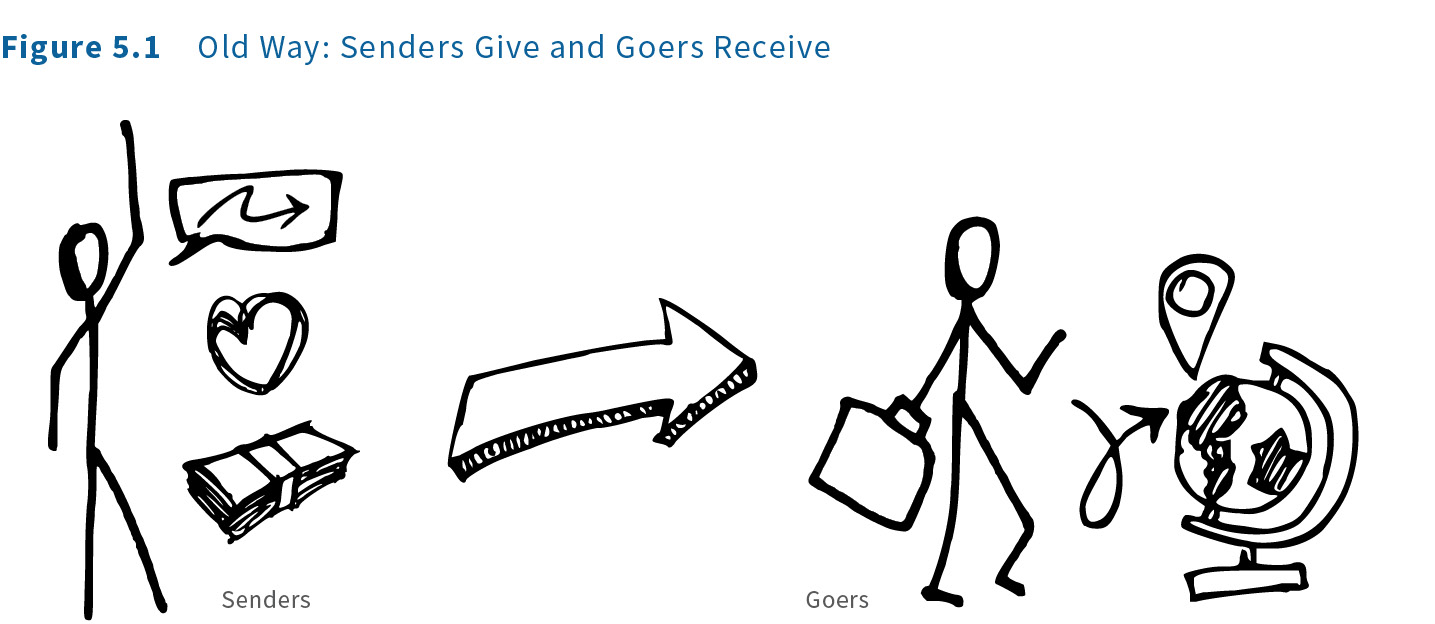
Perhaps Senders have not been trained due to some misconceptions about how mission is conducted. It seems that many church members feel that all missionaries want is their money and to receive. This pattern is shown in Figure 5.1. The Senders give their prayers or finances and receive nothing in return from the Goer. The Senders do receive the opportunity to be involved in God’s work in the nations, but only in a peripheral way through newsletters and occasional visits. Although some Senders feel large ownership over the mission, most seem to feel they are not in the same league as the Goer.
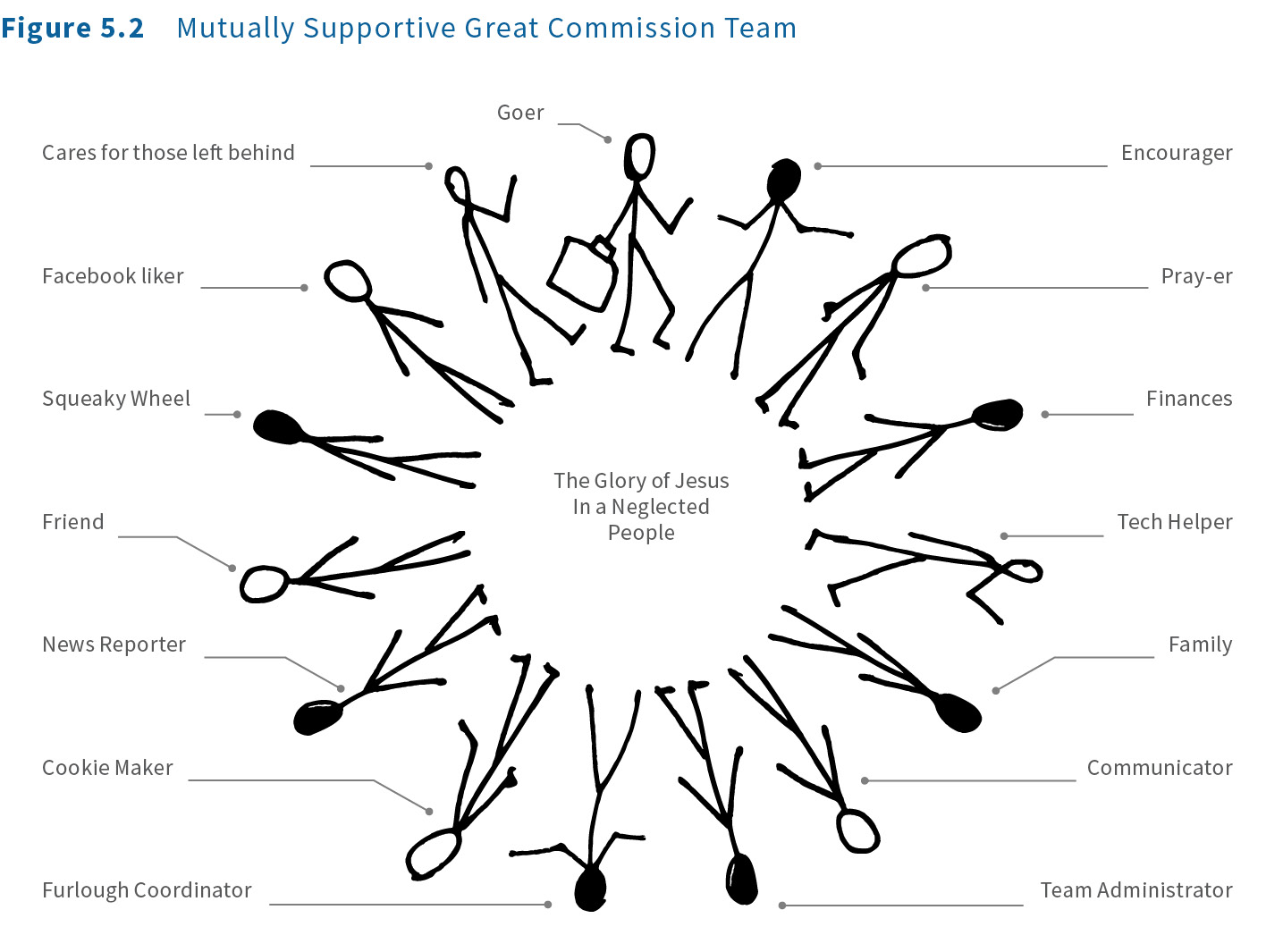
However, if Senders are called and cultivated in their ministries within a mutually supportive team working alongside Goers, then the missionary process is no longer a one-way street with the Goers receiving and the Senders giving. Instead, as are the Goers, the Senders are now mutual givers and receivers. Then the Senders are not only contributing financially and in their prayers but, depending on other gifting and abilities, they are involved in a whole host of other ways. They are no longer only supporting the Goer, but they are an integral part of the team. And, in fact, if the team doesn’t function well, then all the people on the team are affected, not just the Goer.
In Figure 5.2, if one of the team members, say the one who is a FaceBook Liker, is suffering and not able to do his job, then one of the other team members ought to find out why and help him. Such teams need a great deal of administration and coordination. They need much higher buy-in on the front end and a deeper commitment to each other as significant and important in reaching the end goal: making God’s name great among an unreached people group. No one in the group is insignificant and no one in the group ought to see himself as “just an intercessor” or “just a listening ear.” Each person is happy and joyful in their gift, sees its significance to the mission, and owns their contribution and role on the team.
George Patterson, missionary to Honduras and missionary statesman said to me many years ago, “There is no gift of church planting in the Bible because all gifts are necessary to church planting.” And, yet, when most church members are invited to become part of a church planting team as a Sender, no one trains them and they don’t know how to be a part of it.
We met a lady recently who volunteers at a museum. She is required to be at training every week for a year to do a volunteer job. Not only did she do it, but there were more people wanting to volunteer than they could accept, so she had to apply and prove her worth. And yet we have trouble finding volunteers in the church. Perhaps when we ask so little, people feel the insignificance of the task. In this way of Sending, Senders are asked to make a high commitment and are asked to receive training and commit to regular gatherings for mutual edification and to advance the work.
Finding Senders
So, how do we find and prepare the Senders? First, people need to find their place. Such people can be found by local church leaders in their congregations or Sunday School classes or home groups. They might also be found by agency leaders at Perspectives classes, special trainings, or through interactions with people at mission conferences. Such people might also be found in local Bible colleges, Christian schools, university or high school Christian groups on campuses, or even in seminaries. The key is that they are aware of the Great Commission (through the good work of one of the groups in which they were found, most likely) and they are ready to be involved in making God’s name great among the neglected peoples of the earth in any way God empowers them to do so.
As it is now, most such settings talk about the high and lofty calling of missionaries but not of the high and lofty called of Senders. As a result, most people conclude that they are neither privileged to be called as a missionary or are some sort of secondary citizen without a calling. They often feel undervalued and unworthy as Christians because they weren’t called. However, if it is true that all of us are called to make God’s name great in the nations, then we are all called! Just called differently. It’s time to restore the calling of the Senders. The Great Commission cannot be accomplished without literally thousands of such Senders being trained and encouraged all around the world.
Once people are informed of the two large categories of being involved in the Great Commission (i.e. either as a Sender or a Goer), they should receive training. For Senders, our agency has pioneered a new training called Sender’s University. The first training (Senders 101) is a one-day training in which we cover topics such as the high and lofty calling of Senders, different practical ways to be involved in a mutually supporting Sending team, the call to live a wartime lifestyle (cf. Ralph Winter. Reconsecration to a Wartime Mentality), some basics on culture shock and how to support people going through it, and some basic ideas on how to care well for the Goers and their families (including the parents left behind).
Types of Senders
Through carrying out this training, it quickly became clear that there are also different kinds of Senders. Just as not all Goers are gifted or have strengths in the same areas, neither are all Senders the same. We eventually placed Senders into four categories. The grouping was not to put people in a box but necessary since each of these types of people required different training and encouragement. They also needed different on-ramps to offer their gifts. We examine each of the four categories below.
Wild Stallion
These are strong-willed people who can endure hardship. They can be mobile and nimble and are frustrated when things move slowly or seem boring. They are not afraid of work or hard and difficult living or working conditions. Wild Stallion Senders are needed in missions. However, they are often not good team players and do not want to be responsible for other people. Rather than sitting around for a nice conversation or theoretical discussion, they want to get things done. Sometimes such people can get off course and sidetracked into something else if they do not stick to the mission and vision statement.
Wild Stallion Senders are quick to respond to a need, though they do not always stop to ask others about proper protocol to fulfill the need. They see the need and respond. They are willing to work with other passionate people who are willing to be bold and live sacrificially, but they are also willing and able to work alone—sometimes for years. Although Wild Stallions are sometimes difficult to get along with, this does not mean that we simply condone poor character or allow people to be rude or angry. Being Christlike is always the standard for all believers. The point here is simply to acknowledge how these folks are gifted and wired and release them to work in the way in which they will be most successful. Wild Stallions should not be put in a corral or bridled.
Special Ops
These folks are quite similar to the Wild Stallion; however, rather than being lightly coached, they like plenty of coaching and training. They do not want to learn anything abstract but want to be like a specially trained force that is able to do the required work. They are reflective practitioners but also active in the work. Special Ops Senders like to strategize each of their activities and go into them with a clearly thought out and well-rehearsed plan. They like making goals, analyzing them, and moving systematically towards them. Even so, they are also able to adapt, improvise, and overcome.
Special Ops Senders are usually easy to identify because they have often taken every training offered and read every book ever written on the topic of missions. They are often seen sitting in the Perspectives class for the 3rd or 4th time. They are seen engaging the speakers and trainers that come their way with intelligent questions born out of deep thought and a desire to do things well. They volunteer to host Perspectives speakers and other visiting missionaries because they want to be able to ask them questions. They likely read many of the main missions magazines, like Mission Frontiers, EMQ, etc.
Special Ops Senders might show up to Missions Committee meetings or Sending Team meetings with complicated charts they have created. Their solutions are simple and obvious to them but can be confusing or too complicated for others. Such people enjoy discussing strategy, but not merely for the sake of discussion. They become impatient with committees that are led by their heart and compassion rather than strategy. They often know they are extreme and are willing to let their ideas be honed to be realistic, but they have a hard time “watering things down” so that more could participate. They can work well on teams that they feel are strategic or at least trying to be, but they are not likely to be the ones to develop new Senders unless they see such development as strategic. They do not do well on teams that are designed to maintain the status quo.
Special Ops Senders enjoy maximizing their time, talent, and treasure to become the best Sender they can be. They are the ones who figure out that a different way of living would let them give away more of their time, talent, and treasure. It often mystifies them that others aren’t also interested in making changes in their lifestyle so that the Great Commission can be advanced.
Construction Worker
Happy to serve on a team, Construction Worker Senders are not likely to want to be the leader of the team. If they can work alongside a leader, they may carry many of the administrative burdens of coordinating a team, but do not usually want to be responsible for strategic guidance and leadership. They can be committed Senders but will usually be involved in “moderation,” balancing the Sending alongside other things they can do.
When asked to do a task, Construction Worker Senders are usually willing as long as it fits in the context of other activities in their lives. They are especially willing to serve for “one off” activities or in specific circumstances. They might even go to great lengths to do short-term tasks and inconvenience themselves a great deal, if the task fits their other giftings. For example, they might open their home to a missionary family for weeks or months on end if hospitality is one of their primary giftings. Or, they see it is needed and helpful, they might bring food to every Perspectives class. They might give free dental care or car repair or computer help to Goers, even at great cost to themselves. These people usually serve best if someone else is guiding and “coaching” them.
Hub Worker
Hub Workers have traditionally been thought of as “Home Office” staff or perhaps a mission pastor. Unlike the other categories of Senders, these folks are usually working full time as Senders. Hub Worker Senders process finances, provide infrastructure, recruit and train more workers, coordinate teams, etc. However, some might also be “forward advanced” Hub Workers—in a field location but primarily caring for the team. They are the ones who help new people, coach and train the other types of workers, coordinate or administrate teams, care for practical issues like computers, cars, visas, etc. So, Hub Workers might be found at bases in traditional sending locations or part of field teams where their primary job is to care for that team.
Types of Senders Summarized
These categories are not designed put people in a box or to say that one type of Sender is better than another. They grew out of many hours of coaching and training and discovering that not all Senders flourished under the same kind of coaching and training.
The categories are meant to allow for an encouraging dialogue with a caring mentor to make sure Senders are well placed. These discussions have helped to make some team pairings much better and prevent some team pairings that seemed destined for failure. For example, a sweet couple that are Construction Workers wanted to join a couple that are Special Ops to form a Sending Team. We were able to explain to the Construction Workers that they could join that team but that they were not likely to receive much care, chatting, hanging out, etc. They would need to look elsewhere for those things. We did not ask the Special Ops people to change. Nor did we ask the Construction Workers to change. We were able to soberly assess if it could work. In the end, both decided to go their own way but with a respect and admiration for the other. These concepts help immensely in team formation for both Goers and Senders.
Conclusion
Instead of looking for a small, select pool of people with certain gifting, we have come to believe that all giftings are to be used in fulfilling the Great Commission. Some are Goers and some are Senders. Not all have the same ways of working or operating within those callings. One of the keys is to restore an environment of dignity, honor, and worth for the different kinds of Senders. We have seen that when Senders are released to their role and doing it within their personality mix, the Goers thrive, the Senders receive joy and mutual support, and more people groups get a chance to hear about Jesus for the first time.
Pam Arlund, PhD, is the Global Training and Research Leader for All Nations Family, Inc. She has been a church planter among an unreached people group and also trained many Goers and Senders.
Peggy Spiers is the Global Advocate for All Nations Family, Inc. She has served as a Sender by training local believers, serving field locations, and raising up Sending Teams for many Goers.