EMQ » October–December 2018 » Volume 54 Issue 4
[memberonly folder=”Members, EMQ2YearFolder, EMQ1YearFolder”]Voices from the Past
EMQ Archives » Volume 1, Issue 3, July 1965
George W. Peters
The preparation of the missionary must be in keeping with the task assigned him. We are compelled, therefore, to define the missionary task from a twofold point of view. The preparation of the missionary must be in keeping with the task assigned him. We are compelled, therefore, to define the missionary task from a twofold point of view. The task of the missionary contains something of the ultimate, something that neither centuries, circumstances, nor cultures change. There is such a thing as a “changeless task.” But the task of the missionary also contains something of the relative, something that demands changes and adaptations. Unless these two aspects are kept in mind, the missionary cause may be weakened, endangered, and eventually made ineffective.
The missionary’s task is changeless in four ways
- Spiritual task. First, it is a spiritual task, and therefore the missionary must equip himself spiritually. Essentially and ultimately the missionary task belongs to the Holy Spirit. As salvation originated in the eternal counsel of God, and was procured historically in the Person and work of Christ, the eternal Son of God, so it is made experientially real in an individual’s heart by the Holy Spirit. He is the present administrator not only of salvation but also of missions. This is apparent in the Book of Acts. The Spirit’s instrument is the Word of God, and His agent is the church and individuals called out for specific missionary services.
The fact that missions essentially are a ministry of the Holy Spirit is both a comfort and challenge to us: a comfort in that we may trust Him to accomplish His work; a challenge in that only Spirit-filled and spiritually-minded men and women can be used effectively in mission ministries. There is no greater lesson for a would-be missionary to learn than how to live a Spirit-filled life, how to walk and minister in the Spirit. The fact that the final battle is in the realm of the Spirit and spirits can never be emphasized too strongly, though it may be stressed too one-sidedly.
- Biblical task. Second, it is a biblical task, and therefore the missionary must equip himself biblically. Thorough knowledge of the Word of God is essential. There is no substitute qualification. Nothing can justify appointing an individual to the missionary task who does not possess or is not willing to acquire a thorough knowledge of the Word of God.
We are not sent forth as missionaries merely for friendship or to demonstrate the oneness of Christians in the Body of Christ, though these are precious truths and belong in the realm of Christian living. We are not sent forth primarily to share the great benefits of Christianity with the world. We are witnesses to Christ, we are His ambassadors, we are preachers of the Gospel of God and messengers of His message to mankind. Our message is contained in a Book, the Bible, and we gladly bear the world’s scorn that we are a people of one book, messengers of an ancient message. The challenge of the missionary is to be a “sent one”—sent by the Holy Spirit (Acts 13:4) to bear witness to Christ and proclaim the revealed message of God’s redeeming act in Christ.
As our message is derived from and determined by the Bible, so also is our assignment as missionaries. Much confusion exists today about the preparation of missionaries because our assignment has become hazy and blurred. In the words of the late missionary statesman, Dr. Samuel Zwemer, there is a great deal of “gray thinking” about missions. One cause of indefiniteness is that we are not delineating between the biblical assignment to the church and the biblical responsibility of missions. It is here that we need penetrating study of the Great Commission. Only here can we find our theological and practical orientation for our mission. The Great Commission does not set forth the complete divine assignment to the church (this is found in the entire New Testament) but it does set forth the framework and essentials of our missionary assignment. We find our direction for missions not in the needs of mankind as they appear to us, for they are limitless, ever-growing, ever-changing. We receive our assignment from our Captain in His changeless Word. Here is our beacon in the midst of fog and conjecture. Thus, we are thrust upon the Bible as our unfailing guide, which presupposes thorough knowledge of it. We find both our message and assignment in the Bible because the missionary task is a biblical task.
- Task of faith. Third, it is a task of faith, and therefore the missionary must be a man of faith. God has ordained Christianity as a religion of faith. By faith man accepts the salvation offered in Christ. Paul tells us that we walk by faith, not by sight. The letter to the Hebrews says that “without faith it is impossible to please him (God).” From beginning to end, the Christian life is a life of faith, and so is the missionary task. Here not only our love for the Lord and others is tried, but also especially our faith. Do we believe what the Bible says about the marvelous Person and purposes of God, man’s depth of being and height of possibility, the absoluteness, finality, exclusiveness, universality, and individuality of the Gospel, and the temporal and eternal issues disclosed in the Book? These are faith issues, based upon revelation rather than human experience. No human sentimentalism or goodwill is sufficient to sustain the burdens, frustrations, and disappointments of the missionary task. We need deeper motivation. Only a heart set aflame by the Holy Spirit through deep and stirring faith convictions about eternal verities will uphold us in the heat of the battle and in the depth and length of sacrifices.
True missionary work, therefore, can be done only by men of faith, men who without hesitation undertake humanly impossible tasks for Him.
Such faith, though a work of the Holy Spirit, does not come to us overnight, nor does it come automatically or mechanically. It grows only in a certain atmosphere and must be carefully cultivated. This takes time, discipline, patience, humble waiting in the presence of God, abiding in Christ, and absorbing interest in the Word of God. It is no surprise that Paul spent three years in Arabia soon after his conversion and, somewhat later, some five to seven years in Tarsus. He needed time and solitude for theological orientation as well as spiritual maturation before he became the greatest missionary of the early Christian era.
Men of faith are not grown in theological hot-beds or ecclesiastical organizations, though neither do they generate in vacuums. They prosper only in the presence of God, allied with Him for the battles of life. Men of this quality are rare, yet desperately needed. Only men of faith can do lasting work in a world of unbelief. World-overcoming faith is demanded of a missionary, and the cultivation of such faith belongs to the essentials of missionary preparation.
- Human task. Fourth, it is a human task, and therefore the missionary must be a man living in healthful human relationships. God has chosen human instruments to accomplish His task in human hearts in a human society. While humanism and theological liberalism no doubt have overemphasized this, and have made missions almost totally anthropocentric, evangelical Christianity has greatly underestimated it. Man does not live in isolation; he lives in society and in a culture. His culture is the physical, mental, psychological, and religious atmosphere he breathes for his survival and advancement, and which he values for what it does and for what be believes it does.
Man is an interacting being. He is acted upon most successfully and effectively by agents of unicultural relationships. He most readily follows the leader of the in-group and submits to the authority of his own group. If man is to be reached, he must be reached within his culture.
Hence, a tragic dualism often plagues the evangelical missionary. It is not necessarily his love for Westernism that troubles him. (Such love he seemingly left behind when he yielded to the Master for service abroad.) It is far more his fear that through identification he may endanger his testimony to the uniqueness of Christianity, that he may become somehow identified with the sins bound up in the culture of the people he has come to serve, and that the principle of Christian separation and separateness may be blurred by his life.
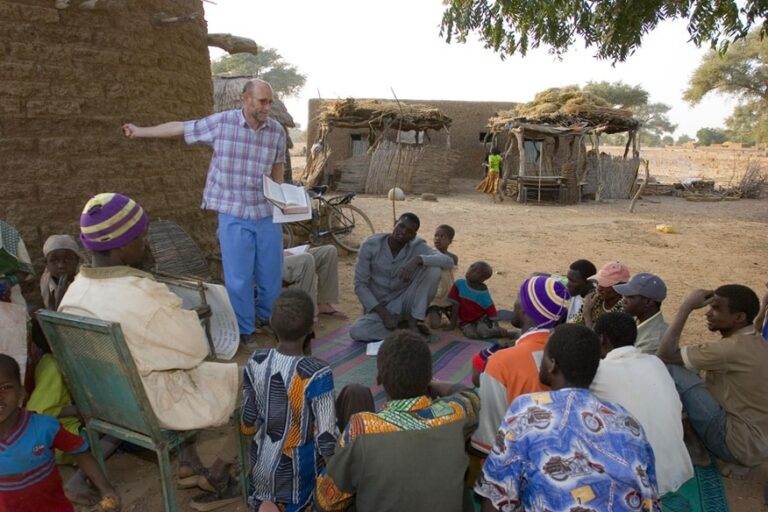
This is a legitimate fear and must not be dismissed lightly. Yet, it is a fear that may enlarge upon us and make the necessary cultural adaptations for identification and integration impossible, and thus may paralyze our effectiveness. No doubt, much weakness in evangelical mission work is because missionaries haven’t been able or willing to make such cultural adaptation, social integration, psychological penetration, and spiritual identification as to make spiritual fellowship deep, lasting, contagious, and vital. Somehow the wall of separation was not broken down, isolationism developed and continued, and effectiveness did not result in the work. There was no real communication or communion with the people. Two worlds, though existing side by side, never met and melted together. The missionary never “sat where they sat,” though he sacrificed much and put forth great effort to communicate a message so precious to himself.
It is not our intention to discuss cultural anthropology and the demands upon us for effective communication with the people we desire to reach with the Gospel. Suffice it to say that missionary work is a human task and can be accomplished only when human relationships between missionary and the people are fully human, and when communication takes place according to divinely created channels involving far more than knowledge of the language.
Such then is the changeless task of the missionary. It is a spiritual, biblical, and human task. It is a task of faith. In these qualities the work of missions never modifies or alters. Let us now turn to the relative aspects of missionary responsibility.
The missionary’s task is relative in five ways
The relative task of the missionary depends upon a number of factors, and the missionary candidate must be cautioned not to grow impatient when his assignment cannot be immediately defined with precision. Trust in God’s personal leading is necessary. In general, the missionary’s relative tasks will involve him in five areas of service.
- Strengthen the Church. First, he must serve the church. This will involve the missionary in an intensive teaching program. The church must be taught “to observe all things.” Its doctrinal and ethical life must be guarded, integrated, and blended. This does not necessarily mean the sponsoring of an educational or institutional program, but rather teaching the Bible’s essential doctrines in a village to village, church-centered program. Appropriate Christian literature is greatly needed.
In the teaching program, the missionary together with the church must face the critical problem of the church’s integration and acculturation in an essentially anti-Christian culture. This is without question one of the crucial problems of the younger churches and requires intelligent study and wisdom. Today anti-Christian cultures, anti-Christian philosophies are rising and seeking to dominate the world. The missionary must assist the younger church to root itself in the Word and be alert to false philosophies.
- Evangelistic Fervor. Second, he must maintain evangelistic fervor in younger churches by example and teaching. Younger churches must be saved from the peril of the status quo. They must expand through energetic evangelism. In this ministry, the missionary will remain the example and inspiration for many years. Much patience is needed to understand the younger churches. We must not forget that most of them came out of relatively static cultures and non-missionary religions, and aggressive evangelism is often a new concept for them. It is true that the Holy Spirit is the dynamic of evangelism, but He usually works through the mental concepts and psychological channels that have been created through teaching the Word of God. Thus, teaching and example are necessary if younger churches are to become an evangelistic force in their communities and eventually in the world.
- National Leadership. Third, he must train national leadership able to cope with present-day problems. Such training has stayed far behind the development of national consciousness, and a dangerous gulf is developing. Evangelicalism has produced many wonderful pastors and evangelists. Yet a serious lag persists in developing men with abilities for national leadership, as well as theologians and church statesmen. Neither have training programs kept pace with the numerous Christian groups springing up. Pastors, Bible teachers, and leaders are needed almost everywhere.
Present training programs are inadequate in preparing men, both numerically and qualitatively. This must be remedied, and it must be done quickly if the younger churches are not to suffer severely.
- Pioneer Work. Fourth, he must do pioneer work. Missions always includes pioneer work. Numerous smaller geographical areas, many towns and villages, as well as large numbers of tribes, are untouched by the Gospel of Jesus Christ. If the command of Christ to preach the Gospel to every creature is to be fulfilled, much pioneer work remains.
- Technical Ministries. Fifth, he must perform certain technical and professional ministries. Such ministries include radio, printing, literature, linguistics and translation, medical service (doctors and nurses as well as teachers in specialized areas), and teachers in schools for missionary children. These and other areas call for technically and professionally trained people.
Indispensables
In the light of both the changeless and the relative aspects of missionary responsibility, should not our objective be to pray for and train missionaries with certain indispensable qualifications? I think we need people today who are spiritually healthy and personally mature, with a message from God derived from the Scriptures, and with the ability, love, divine compulsion, and divine authority to communicate that message to men.
Dr. George W. Peters, a Russian immigrant, became Professor of Missiology at Dallas Theological Seminary in 1962, where he served for fourteen years. He also served for twenty-five years on the Mennonite Brethren Board of Foreign Missions. He authored ten books, including a classic mission text, A Biblical Theology of Missions (Moody Press, 1975).