EMQ » April–June 2018 » Volume 54 Issue 2
[memberonly folder=”Members, EMQ2YearFolder, EMQ1YearFolder”]Book Review
Building Bridges to Oral Cultures: Journeys Among the Least-reached
By Carla Bowman with James Bowman
William Carey Library, 2017
ISBN: 978-0878084951
255 pages
USD $16.95
Reviewed by Scott Hedley, who has been involved in Bible translation in southeast Asia for over 20 years.
I agree with the importance of taking an oral approach to sharing the Good News about Jesus Christ because there are over four billion people in the world who can’t, don’t, or won’t read. Few, if any, of these people, would read scripture, even if it was published in their language. In fact, even after fifty years of literacy instruction among the Tzeltal Mayas, the masses of highly evangelized Tzeltal people remained resistant to reading (67).
Enter Carla and James Bowman. In the 1980s, they began work among indigenous people with a unique assignment in the field of minority language scripture use and promotion. They are founders of Scriptures in Use (1987), an organization focused on global training for people groups of oral tradition. Early in their ministry, they realized that working with local leaders would be key for effective ministry. So the Bowmans sought to identify, train and serve local leaders.
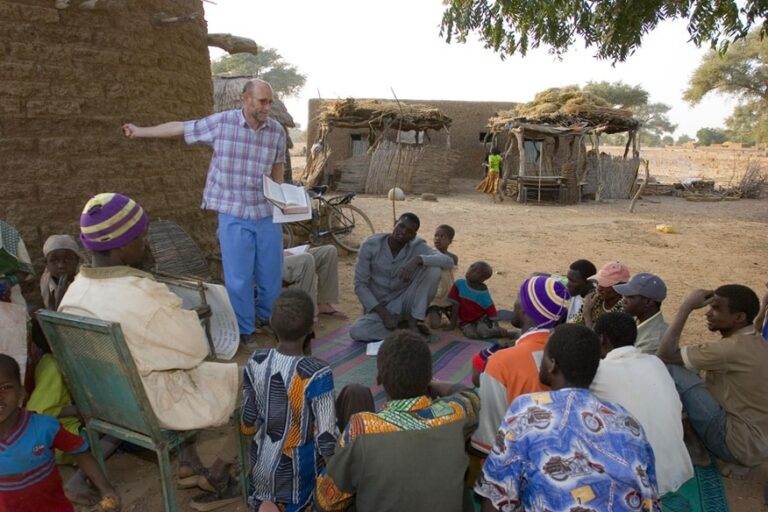
The use of stories and dialogue was proving to be one of the most effective strategies they developed. Dialogue after each story was essential to discovering Biblical truth together as a group. This dialogue also made the scriptures more memorable than a sermon about the passage. Also, the use of dialogue made it easier to discern true conversion.
The Bowmans also realized that some of our Western methods of evangelism are counter- productive when working with minority peoples. For example, asking minority people to come forward to ‘accept Christ’ after seeing a Christian film was counterproductive in a culture where the only time a person is set apart from the group is for tribal ostracism or punishment. In many minority cultures, decisions are rarely made individually, instead, they are made as a group.
I was also enlightened by the authors’ reference to Michael Mamo of Ethiopia. Mamo referred to a Muslim sheik who indicated that holding a Bible leads to opposition but no one opposes stories but listens to the end.
The authors wisely do not dismiss print media or literate methods. Since print is an aid to memorization, some readers are required in order to get an accurate oral form of scripture transferred to oral learners.
As I read through this book, I was hoping to see a curriculum of how the authors trained local people to establish fellowships of believers. But that was not provided and that apparently was not the goal of this book. Instead, the authors basically narrated their experiences in various people groups throughout the world. The back cover of the book mentioned a new comprehensive, oral communication model. I wanted to see if I could try that model in my area of Southeast Asia. But I could not find out how to follow that model in my area. If this book is ever revised, I would suggest that the authors include an index so that readers can look up topics of interest.
For Further Reading
Bishop, Bryan. Boundless: What global expressions of faith teach us about following Jesus. Grand Rapids, MI: Baker Books, 2015.
Claydon, David. “Making Disciples of Oral Learners,” Lausanne Occasional Paper 54. Pattaya, Thailand: Lausanne Committee for World Evangelization, 2005.
Klem, Herbert V. Oral Communication of the Scripture: Insights from African Oral Art. Pasadena, CA: William Carey, 1982.