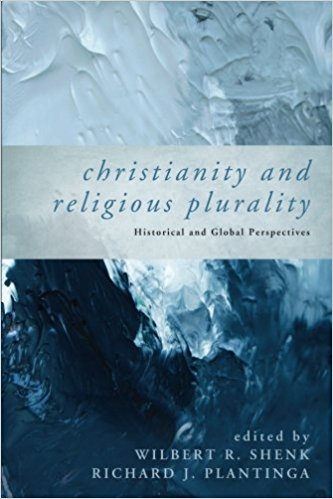
by Wilbert R. Shenk and Richard J. Plantinga, eds.
Cascade Books, 2016.
—Reviewed by Larry Poston, professor of Religion, Nyack College.
This volume is comprised of papers presented at a 2003 symposium that “emerged out of a sense that the pluralism paradigm was exhausted” (p. 20). The editors of this work consequently suggest that instead of the concept of pluralism—an “ideology that all religions are expressions of a common essence” (p. 4)—one should instead speak of plurality—an acknowledgment that human societies have always contained multiple religious systems that remain clearly distinct from each other.
As is the case with most edited works, the quality of the individual articles varies greatly. Chapter 1 seems to portend good things to come, as John Goldingay’s “’Yhwh Our God Yhwh One’: Religious Plurality and the Old Testament” contains an excellent discussion of Old Testament theology as it relates to the non-Israelite religious systems mentioned therein. There is a section on “the shortcomings of Baal religion” (p. 18ff); on religions of the Babylonian and Persian periods (p. 22ff), and those of the Greek period (p.23ff). Goldingay succinctly describes the tension that exists between the exclusivistic and (seemingly) inclusivistic passages of the Old Testament record.
The best contributions, however, appear at the end of the volume. Paul Cornelius’ “Hinduism in the Twentieth Century” gives a very useful overview of the development of Hindutva, which essentially represents a reversal of the previously existing Western-inspired trends toward pluralism in India. Cornelius includes a thorough historical background of the phenomenon, along with practical suggestions for a biblical Christian response.
Jehu Hanciles’ “Keeping Faith: Immigration, Religion, and the Unmaking of a Global Culture” contains a very fine discussion of the decline of the twentieth century’s ‘secularization’ thesis and the rise of the notion of plurality in its place. Included in the chapter is an enlightening analysis of the “culture of migration” as seen in the estimated (as of 2003) 191 million international migrants in the world (long before the present refugee crisis spawned by those fleeing from the Islamic State—making the article more timely than ever).
Finally, Veli-Matti Kärkkäinen’s “The Future of Pluralisms—and Why They Likely Will Fail” is a highly insightful discussion regarding pluralistic thought within various Christian contexts. The author speaks of “First Generation Pluralisms” contained in the thinking of such proponents as John Hick and Paul Knitter, and moves to an analysis of “Trinitarian ways of constructing pluralistic theologies” (p. 291). After a list of the “broken promises of pluralisms” (p. 300ff), he supplies his own take on the “Trinitarian sign-posts on the way toward a hospitable interreligious co-habitation” (p. 302ff). His conclusions contain a very useful discussion of the concept of ‘tolerance’ and how most contemporary Christians are completely mistaken in their attempts to adopt and apply this concept.
Check these titles:
Clarke, Andrew and Bruce Winter, eds. 1992. One God, One Lord: Christianity in a World of Religious Pluralism. Grand Rapids, Mich.: Baker.
Conser, Walter and Sumner Twiss, eds. 1997. Religious Diversity and American Religious History: Studies in Traditions and Cultures. Athens, Ga.: University of Georgia Press.
Kärkkäinen, Veli-Matti. 2003. An Introduction to the Theology of Religions: Biblical, Historical & Contemporary Perspectives. Downers Grove, Ill.: IVP Academic.
. . . .
EMQ, Vol. 53, No. 4. Copyright © 2017 Billy Graham Center for Evangelism. All rights reserved. Not to be reproduced or copied in any form without written permission from EMQ editors.