by Larry Dinkins
In 1963, Ralph G. Braun began a home Bible study. But his study was a bit different. He used a chronological approach, hand signs, and a map laid out in his living room. Braun called this unique method Old and New Testament Walk-Through.
In 1963, Ralph G. Braun began a home Bible study. But his study was a bit different. He used a chronological approach, hand signs, and a map laid out in his living room. Braun called this unique method Old and New Testament Walk-Through.
In 1972, a student at Dallas Theological Seminary, Bruce Wilkinson, took Braun’s prototype and expanded it into a daylong teaching seminar he called Walk Thru the Bible (WTB). In 1974, I attended my first Walk Thru seminar. I had taken survey courses in seminary, but none of them were able to put the Old Testament together so coherently in such a short time frame. Bruce was able to cover a 110-point outline of the Old Testament by placing us in the geography of the Middle East and visually moving us from point to point.
I was intrigued by the method but never realized the impact that the WTB method would have on my future ministry in Thailand.
A DISJOINTED VIEW OF HISTORY
Six years of church planting and TEE training had brought to the surface a major problem of biblical illiteracy among Thai lay leaders. My concern was heightened when, as a teacher at Bangkok Bible College, I found that my students seemed unable to piece together even a rudimentary picture of the plan of God as found in the Old and New Testaments. Tom Steffen finds this to be a universal problem, saying,“Bible training institutes often promote fragmentation. . . . A fragmented grasp of the Bible often results in some people missing the big picture. Caught up in the details of minutia, Bible students often fail to see God’s overall plan.”1 This disjointed view of Scripture by leaders has had a direct affect on the laity.
A Thai leader commented, “Thai Christians are unable to put events in the Bible into any sort of a timeline. This affects negatively their ability to understand both sermons and in their own personal study.”2
The news of WTB’s international expansion renewed my initial interest sparked in 1974. Could the WTB method be an answer to the Thais’ disjointed and piecemeal understanding of the Bible? Would the Thai see it as a relevant seminar or just another novel farang (foreign) method, unsuited and untested in Thailand? There was only one way to tell: Translate the seminar, research the method, and evaluate the results.
THE WTB METHOD
Forty seminars, numerous interviews, and group testing performed in all parts of Thailand have confirmed the Thais’ warm reception of the WTB method. The reasons are numerous but are best described by Bruce Wilkinson’s own four-point summary.3
The four points are: (a) Synthetic—gives an overview of the “forest” (broad sweep of Bible) with little stress on the “trees” (details); (b) Teacher accepts responsibility for the student’s learning; (c) It is memorable—contains a variety of mnemonic aids; and (d) It is fun.
Synthetic. Most people are able to identify isolated characters or stories from the Bible but are hopelessly lost when asked to put them into their context.
The WTB method creates mental pegs for major people, places, and events of the Bible and arranges them in their chronological order. Instead of a disjointed pile of jigsaw pieces, the participant in the seminar will have a composite picture of the whole with each piece in its proper chronological position.
Participatory. During a long seminar, it is especially important to keep the students actively involved. Jim Wilhoit and Leland Ryken state, “Educational research has shown again and again that students learn best when they enter into class activities and take an active role in learning as the teacher does in teaching.”4 Hand signs accompany each point in the outline. The Thai are highly expressive and graceful with their hands and take a special interest in this part of the seminar. Such hand signs, however, must be checked carefully to make sure they are appropriate. In “Dos and Taboos Around the World” the author states, “Gestures pack the power to punctuate, to dramatize, to speak a more colorful language than mere words. Yet, you may discover that those innocent winks and well-meaning nods are anything but universal.”5
Memory techniques. The Thai are taught from their youth to orally recite facts to their teachers in a group setting. This fits in nicely with an integral part of the seminar, repeating the outline out loud together. The outline and key words are reviewed throughout the day through different oral and visual memory aids. To insure variety, a teacher can choose from numerous review methods for group use and hand signs. Acrostics, songs, pictures, and object lessons are all used to improve retention of the core ideas.
Fun. Without the element of fun, a five-hour seminar can become quite boring. The concept of fun or enjoyment is also a core Thai value they call sanuk. Robert Mole states, “Happiness seems to be the apex and sum of the other Thai qualities, values and behaviorism. It is descriptive of the uncompulsive enjoyment of life which is the ideal of the Thai.”6 Chaiyun Ukosakul shows why it is important to maintain a sanuk atmosphere: “The concept of sanuk is closely tied with the level of interest in the activity at hand. If the Thai do anything and do not feel sanuk, they will become bored and have no desire to continue with it.”7 As with gestures, cross-cultural humor is tricky and should be spontaneous and transparent, not contrived or canned.
FLEXIBILITY, ADAPTABILITY AND TRANSFERABILITY
A WTB seminar is like a piece of sausage that can be cut to any length. It is usually taught in four to five hours but can be reduced to two hours and 30 minutes if necessary. I have also expanded it to a 40-hour TEE class. The adaptability of the method can be seen from the numerous cultures where it is taught.
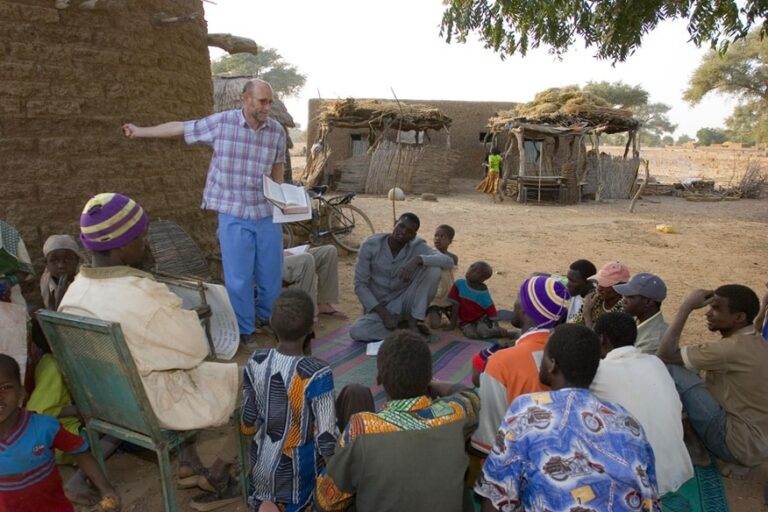
In some places in Russia, the workbook is only two pages long and the outline is cut in half due to a scarcity of materials and time. One innovative teacher in Australia taught the Old Testament to aboriginals using picture graphs hung on large sheets under the trees. At least 50 participants are preferred to create group dynamics, but the seminar has been taught to only a handful or to thousands as at Willow Creek Community Church. WTB is easily translated into other languages, as evidenced by the 51 languages and 71 countries in which it is taught. John Hoover of WTB describes further adaptations: “It is used as a tool in illiterate contexts (Africa); an evangelistic tool (Kenya); a church planting tool (India); a seeker sensitive tool (aboriginal tribesmen—Australia); a 77-step Thru the Bible (Russia) and a long-term curriculum tool (Ukraine).”8
TWELVE SIGNAL SYSTEMS
One puzzling aspect of the WTB method has been its wide acceptance despite the absence of any real effort at contextualization. Often the outline and handbook are translated word by word from English and taught according to the American model. Yet people of different learning styles and ages have affirmed its cross-cultural appeal. Donald K. Smith,9 in his research on the 12 signal systems of communication, has been helpful in solving this puzzle.
Smith maintains that all human communication occurs through 12 signal systems or “pipes.” Using several signal systems in combination is similar to adding more pipes to a water system. A larger number of pipes carries more water. Similarly, each added signal system increases the information load carried. If one system fails to be understood, a total loss of communication does not occur because other signals systems are carrying the same or related information.
1. Verbal—speech (the majority of the six-hour seminar is speaking).
2. Written—symbols (the manual has text, charts, and diagrams).
3. Numeric—numbers (periods of years and dates are mentioned).
4. Pictorial—two-dimensional (the manual, overheads, and pictures).
5. Artifactual—three-dimensional (object lessons).
6. Audio—nonverbal sounds and silence (music, reflection times).
7. Kinetic—body motions (hand signs).
8. Optical—light and color (the four-color manual and overheads).
9. Tactile—touch (attendees sometimes give each other a back rub).
10. Spatial—utilization of space (layout of room as a map).
11. Temporal—utilization of time (schedule of the day, breaks, lunch).
12. Olfactory—taste and smell (one exception).
WTB works cross-culturally because it uses 11 of the 12 pipes. Many teaching techniques stress only one or two pipes. The broad appeal of WTB is found in the large number of teaching styles that are bound to match at least some of the predominant learning styles in a given culture. This explains why a largely Western method can “cross over” into other cultures.
CONCLUSION
Twenty-five years ago, Bruce Wilkinson had a vision for a Bible teaching method that would unleash the communicative power of biblical narrative. He designed his seminars for maximum impact through a variety of creative methods. Twenty years ago that vision was transported across the sea to what is now a worldwide ministry reaching 51 languages and 71 countries. What began in an American living room is now a cross-cultural tool that plans to expand throughout the world, as Bruce Wilkinson’s vision of saturation Bible teaching becomes a reality through WorldTeach (see sidebar on page 486).
Endnotes
1. Tom Steffen. Reconnecting God’s Story to Ministry: Cross-Cultural Storytelling at Home and Abroad (La Habra, Calif.: Center for Organizational and Ministry Development, 1996), pp. 45-46.
2. Manot Jaengmuk, Kronggan Gansuksa Prakamphi Beeb Walk Thru The Bible Gab Kristajaknongtin Thai [Walk Thru the Bible Bible Study Program and the Local Thai Church.], B. Th. dissertation. Bangkok Bible College. 1992, p. 23.
3. Angela E. Hunt and Laurie McCauley, “Bruce Wilkinson Makes the Bible Come Alive,” Fundamentalist Journal, 7:7-13. 1988.
4. Jim Wilhoit and Leland Ryken, Effective Bible Teaching (Grand Rapids, Mich.: Baker Book House, 1990), p. 67.
5. Roger E. Axtell, ed. Dos and Taboos Around the World (Elmsford, N.Y.: The Benjamin Company, 1985), p. 39.
6. Robert Mole, Thai Values and Behavior Patterns (Rutland, Vt.: C.E. Tuttle Co. 1973), p. 85.
7. Chaiyun Ukosakul. A Study of the Patterns of Detachment in Interpersonal Relationships in a Local Thai Church. Ed. D. dissertation. Trinity Evangelical Divinity School. 1994, p. 79.
8. John Hoover (personal correspondence).
9. Donald K. Smith. A Handbook for Christian Communication Across Cultural Landscapes (Grand Rapids, Mich.: Zondervan Publishing House, 1992) p. 144.
—–
Larry Dinkins is a Dallas Theological Seminary alumnus (Th.M.) with 20 years of experience as a church planter and Bible teacher (Bangkok Bible College) in Thailand with OMF International. This article summarizes some of his findings for his Ph.D. in cross-cultural education at Biola University, La Mirada, Calif.
EMQ, Vol. 36, No. 4, pp. 484-488. Copyright © 2000 Evangelism and Missions Information Service (EMIS). All rights reserved. Not to be reproduced or copied in any form without written permission from EMIS.