by Del Chinchen
The patron-client style of discipling is practiced naturally by many national Christian leaders.
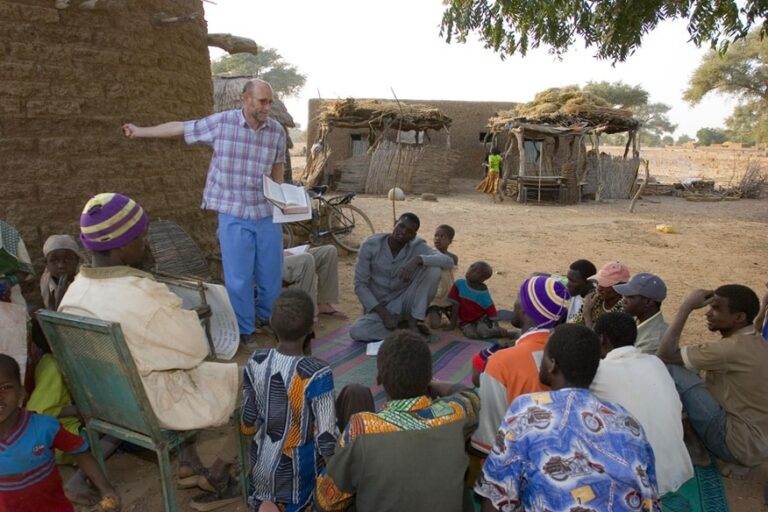
Daddy Teah, a highly respected elder of the Liberian Inland Church and a good Bible teacher, invites Zeambo, a younger member of the church, to sit with him. Zeambo is delighted. His life has been transformed since Daddy Teah began teaching him the Bible. After several months, they are committed to each other for life.
What brought these two men together? How did their relationship grow? How did it build Zeambo spiritually? Can missionaries, in effect, fulfill the role of Daddy Teah? They can, if they understand the patron-client system found in most non-Western societies. This indigenous style of discipling is practiced naturally by many national Christian leaders.
MISSIONARY AS PATRON
Whether they like it or not, educated Americans automatically are placed in a higher bracket. For a number of reasons, they are viewed as potential patrons.
1. Missionary status. Missionary anthropologist William Reyburn tried very hard to shed this role as a missionary patron, but he could not. He dressed, talked, and behaved like the people, but they still called him patroncito because he did not have an Indian mother.
2. Missionary wealth. Missionaries are perceived to be patrons because of their material resources. They own cars and fly back and forth to America. That’s all it takes. The simple lifestyle will not change their “Big Man” image.
3. Missionary age. Having a wife and children indicates age and maturity. In patronage practicing cultures it’s inappropriate for older people to relate to younger ones, except through rituals of the patron-client system.
FOUR STEPS
It takes four steps to establish a relationship with a potential patron: admiration, visits, token gifts, and request. By identifying these steps that which has been intentionally kept secret is made explicit. Local patrons try to hide the symbols and rituals, so as to monopolize the client market. Social management of knowledge, as it pertains to client procurement, is essential to the possession and use of power in the community. The last person who usually has the privilege of possessing this knowledge is the foreign missionary.
Step 1: Admiration. The client’s expression of respect and love for the patron is the initial sign of a potential relationship. The client desires to be like this admirable leader.
Step 2: Visit. The client, moved by admiration, usually makes the first visit. This enables the patron and client to become acquainted, to determine one another’s needs, and to build trust.
Missionaries sometimes complain, Why do I get so many visitors? However, the local patron, who understands the system, is thrilled to receive visitors. They are feathers in his cap, since his wealth and success are found in followers, not in material things. The more visitors he has, the more respect and influence he enjoys. The client perceives the visit to be an investment in the relationship and a contribution to the patron’s prestige.
Of course, missionaries discover that sometimes charlatan clients pursue a relationship only for what they can get out of it. That’s why this four-step “Big Man Mountain” has been erected. It’s designed to be difficult to scale, to protect patrons from insincere people, and to allow the patron to study the client’s motives.
The four steps must be taken slowly, over a period of months, giving the missionary-patron time to analyze the potential client’s behavior, to see if the would-be client shows humility and sincerity—qualities a patron looks for in a client worth the investment.
Beware of clients who try to take a short cut up “Big Man Mountain” by making a request of the patron prior to the visit, or the giving of a token gift. During the war in Liberia, I received a first-time visit from two soldiers asking for money. I told them I had 84 “children” at the college I directed, and their needs came first. I also pointed out that this was the first time I had met them. I suggested they come again.
They did and I gave them some Christian literature, prayed with them, and gavethem some food. They visited me two more times, to talk about their problems and pray together. They never asked for money again.
Experienced clients know when they are violating patron-client traditions, informal as they may be. However, they will transgress those unwritten laws if they are dealing with an inexperienced, gullible patron, such as a foreign missionary.
Missionaries get frustrated by many requests; they feel they must always give something. The “Big Man Mountain” gives the missionary a good reason to be shocked by presumptuous clients’ requests, and to remind them that the relationship has not progressed far enough. The missionary can show interest in getting to know the client better, but based on the patron’s timetable, not the client’s. The patron must make the client follow the proper route up “Big Man Mountain,” or else the patron will be overwhelmed with requests from clients who hope for quick responses.
Step 3: Token gift. The token gift indicates serious interest in the relationship and a willingness to make the first tangible investment. Taking such a risk shows the client’s sincerity and extremity of need.
The Mano dialect in Liberia has a specific word for this token gift—londor—bidding you to open the way to give something bigger than has been given to you. In Liberian English it is said, “You raise it,” or, “Keep it and let it get more.” This sets the stage for a later, bigger request.
If missionaries do not understand the traditions and patterns of patron-client behavior, they can harm a relationship. Before I fully caught on, Dweh Wiah asked me, as his professor, if I would be a sponsor in his wedding. I was very busy and did not understand that although it can be a burden to be a patron-sponsor, it is also an honor and a privilege. So I declined. The next day Dweh sent me a letter with $10 in it, and again asked that I sponsor his wedding. I was infuriated and insulted. Who did he think he was? He could not even pay his tuition, yet he gave me money.
I look back on this with shame and regret. Dweh was simply, in his appropriate way, trying to start a patron-client relationship with me through the “bidding gift.” He gave me the chance to enhance my reputation, honoring me as the sponsor of his choice. He hoped that his $10 investment would reap a larger amount of dividends in sponsorship assistance.
Step 4: Request. After performing all of the required protocol—visits, token gifts, and laying a foundation of trust—the client finally marshals enough courage to request some tangible or intangible assistance. He has tried to prepare the way so that a positive response will be forthcoming from the patron. To be refused would be humiliating and devastating. If the patron says No, when he has the ability to help, the relationship dies and the patron’s reputation is tarnished.
Missionaries often ask, Why are they always asking for something? Requests arise not so much out of a need for material things as from a desire to be linked symbolically, as patron and client. The patron-client system involves social relationships as much as the exchange of material things.
When the patron grants a request, it’s a sign that the relationship is becoming “thicker” (deeper). The client’s request is an attempt to sound the depths of the patron’s love and commitment, so that should disaster strike, the client has someone to fall back on.
The patron is not obligated to meet the client’s request in full. He may ask the client to come back later, or he may only be able to fulfill part of the request. If so, he says, “This is all I have in my hand today.”
When the client is put in a position where he cannot repay, then the patron’s gifts are like poison. Missionaries have been heard to say, “The more we give them, the more ungrateful they become.” That’s because the paternalistic missionary has contributed to their self-negation.
The patron-client system is not paternalism, because it requires reciprocity. The patron needs the client as much as the client needs thepatron. A proverb says, “The little man can reach his hand into the pot, and the big man can reach his hand into the barn loft.”
WHAT IS REQUIRED
1. The system requires that the patron be needy and empathetic. American missionaries tend to be self-sufficient. It’s hard for them to be needy. But not to receive from others makes them look superior. If you have no needs, invent them. Ask clients to give valuable information in the community, to help with language study, and to advise on cultural issues.
My wife and I had helped a student, David Sumwabe, by bringing his wife out of danger in Liberia so that she could deliver her baby in Côte d’Ivoire. When we returned to Liberia several months later, David reciprocated. He planted a large garden of sweet corn just for us, and brought the corn when he knew we needed it.
2. The system requires exchanging visits. People make small investments in the patron’s account when they visit. When the patron does not return the visit—especially when the client is sick or mourning—the patron is perceived to be immoral, unfaithful, and untrustworthy. The missionary-patron’s integrity is at stake. He or she is judged to be a poor manager of relationships.
An upright, moral, faithful, loving patron maintains and cultivates deep, lasting relationships. He is bankrupt and a complete failure if he is void of close, committed, “thick” relationships.
3. The system requires exchanging gifts. I had been giving Grulie Younquoi, a freshman, the intangible gift of knowledge, so she brought me rice grown on her farm. As gifts increase in value, the relationship grows deeper. Shallower relationships involve gifts such as knowledge, visits, and uncooked food. Deeper ties call for cooked food, chickens, or goats.
Exchange of people indicates unbreakable connections. When a client names a newborn after a patron, the client expects the patron to accept that child as his own. The Christian patron, now an “uncle” or “aunt,” is expected to help not only materially, but spiritually as well, by passing on the Christian values the client admires in the patron.
PATRON GOALS
1. Support. The goal is to build strong, durable, lasting relationships, so that in times of crisis the client will be there to help. I have been grateful for faithful clients who have helped me in times of need.
When I had to dismiss a soldier from the college for stealing, he began to march straight to military headquarters to complain. But a graduate-client of mine and a pastor intercepted him and arranged a meeting with him and two other graduates. They cooled him down and convinced him not to go to headquarters. I didn’t find out about this for three months. People can enhance or hinder missionaries’ ministries, depending on the relationship.
2. Influence. People are wealth. The more clients (“children”) one has, the more influence. The more visitors, the more prestige. The larger the entourage, the greater the importance.
The Christian patron sees the client not as someone to be used, but as a spiritual child. The patron-client system becomes an indigenous discipleship model used by church elders like Daddy Teah in Liberia and the apostle Paul, who wrote: “. . . for in Christ Jesus I became your father through the gospel. I exhort you therefore, be imitators of me. For this reason I have sent to you Timothy . . . and he will remind you of my ways which are in Christ” (1 Cor. 4:15-17).
3. Immortality. Christian patrons are not interested in leaving an immortal name behind. The Christian’s goal is to leave behind the knowledge of Jesus Christ. The Christian patron’s goal is to phase out the dependency relationship so that the client leans more on his heavenly Father.
Lester Chikoya, a Christian Malawian leader, had given financial aid and advice to a struggling disciple. After two years of training, his disciple learned how to be responsible with his money. Lester’s client gave him 1 kwacha and declared, “I am now a financially responsible person.”
We began with the story ofDaddy Teah and Zeambo. Zeambo explained: “Daddy Teah would open his mind to me and share his deep secrets with me. He would come to where we live and visit us. When he got older, I would do any little thing for him. I would take him chicken, salt, soap. After a few weeks to a month, he would bring me a mat. Sometimes, when I didn’t expect it, Daddy Teah would bring meat to me. If I cooked rice for him, I would say, ‘What we have, this is a small one for you.’ Nothing but death can separate us now.” As missionaries enter deep, long-lasting patron-client relationships, they will find cherished Christian values easily flowing from them to their disciples.
—–
Copyright © 1995 Evangelism and Missions Information Service (EMIS). All rights reserved. Not to be reproduced or copied in any form without written permission from EMIS.