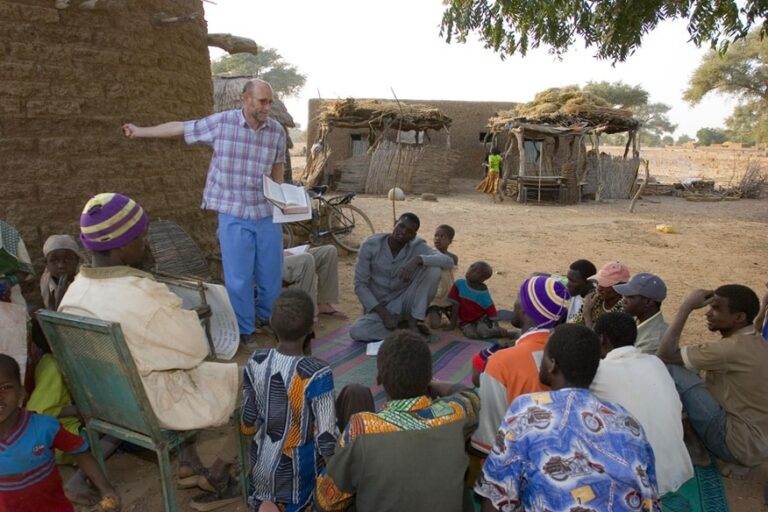
by Richard Gehman
Why spend time studying a dying religion? Nearly a decade ago, researcher David Barrett predicted that by the year 2000, about 84 percent of Uganda, 83 percent of Zambia, and 82 percent of Kenya will have embraced Christianity.
Why spend time studying a dying religion? Nearly a decade ago, researcher David Barrett predicted that by the year 2000, about 84 percent of Uganda, 83 percent of Zambia, and 82 percent of Kenya will have embraced Christianity.1 Apart from a resurging interest among university students, most of the adherents of traditional religion are the aged, the dying, and the unreached tribes, so why study it?
The truth is, it’s impossible to understand contemporary Africa without understanding its traditional religion. A missionary who would communicate Christ effectively, whether the audience be modern or traditional, must know Africa’s religion thoroughly. Let me illustrate.
A prominent Nairobi advocate, the leading African criminal lawyer in Kenya, S. M. Otieno, died suddenly. His wife said he would be buried on his farm near Nairobi, but his clan objected: He must be buried at his ancestral home. The legal battle lasted five months and gained top play in the newspapers. Finally, the court of appeals ruled in favor of customary tribal law, contrary to the wishes of the deceased and his wife.
One can view this fascinating case from different angles. In one sense it was a tribal problem. Mr. Otieno was a Luo, but he had married a Kikuyu woman. Emotions ran deep. People packed the court, which exploded with wild cheers among the mostly Luo when the judges awarded the body to the Umira Kager clan.
Another perspective is the clash between the traditional and contemporary life, and between African customary and English common laws used in modern Kenya. Mr. Otieno was a modern, cosmopolitan man. Though he honored the traditions of his ancestors, he had departed from any deep attachment to the Luo customs of his rural home. He never built a house in Luo land, never owned land there, and seldom visited his roots. He had married a Kikuyu, attended a mission-sponsored school, and been baptized as a Christian.
However, in the end, the court ruled that, given a conflict between common law and customary law, the latter is given precedence. The judges ruled that the courts are guided by African customary law, provided that such laws are “not repugnant to justice and morality.” They concluded that Mrs. Otieno’s lawyer had not shown that traditional Luo burial customs were opposed to justice and morality.
However, from another perspective, beneath the surface lurked another, more fundamental reason the clan felt obligated to bury the deceased: Luo traditional religion. During the hearings, both sides acknowledged that Luo customs are changing: technologically, educationally, politically, culturally, and, to some extent, religiously. Why, then, did they insist on their traditional burial customs? Because, although superficial customs change over time, the more deep-seated beliefs persist.
Beneath the explicit struggle over traditional versus contemporary values lies the traditional world view of the Luo, which is religious at heart. African traditional religion provides the basic presuppositions for much traditional and contemporary culture.
Said Mr. Otieno’s brother, “If my late brother’s body is not buried at home, Wambui (the widow) and her family will have bad luck.” He meant that ghosts and spirits would haunt family members. Further, clan members said, if the court did not grant authority to bury the body at the ancestral home, they would follow traditional burial rites for someone lost at sea.
The Luo believe that when a man dies, his spirit continues to live, transformed into an ancestral spirit known as jachien. The body dies, but the person remains alive and active among the clan, for good or ill.
These ancestral spirits, the “living dead,” in the words of John Mbiti, can benefit the living. More often, they wreak “ghostly vengeance.” When the jachien is offended by a living person, he causes sickness and death.
So, to keep from being haunted, the Luo must keep the traditions. To break them would surely bringrevenge from the ancestral spirits. Such traditions include the proper mode and place of burial, and driving away the ancestral spirit at funerals.
At funerals, Hans-Egil Hauge has seen “a wat dance in full regalia, complete with spears and shields” performed, “accompanied by frenzied drum beats and other loud noises from various instruments.”2 This is to drive away the spirit of the deceased, together with other ancestral spirits who may attend the funeral to harm those present.
Luo follow this custom today. They are not an unreached group: As of 1972, 90 percent professed to be Christian. Yet now, from time to time, they come to funerals from distant places with all their cattle. While the drums beat and feelings run high, they drive the cattle and the spirits of the deceased a long way to some river or lake, to escort the spirits of the dead so they will not haunt the living. The people then return with their cattle. Even when this is not done, the Luo remember the reasons for the tradition.
Among the Luo who participated in the Otieno burial case were Christians who saw nothing wrong with traditional burial rites. Pastors testified and defended the practices. They quoted from the Bible to support some of their customs. Although they conceded that if Luo customs were contrary to Christianity, they should be abandoned, they did not believe the traditional burial rites were irreconcilable with morality and the Christian faith.
African traditional religion is neither dead nor irrelevant. If we are to understand and interpret why people do and say what they do, we must understand their religious world view, which provides the assumptions for customary laws.
African traditional religion is not a religion in the Western sense, something separate from the rest of life. It permeates all of life; it is a total world view, with corresponding values and beliefs. There are at least five reasons we should study it.
1. For its own sake. We climb mountains just because they are there waiting to be explored. In the same way, we ought to study African religion because it is one of the world’s religions from a great people with a great past. Formerly embraced by a whole continent, it persists and shapes the attitudes and actions of millions of people, despite the introduction of Christianity more than a century ago. African religion is a legitimate concern for research.
2. It is the background of people we are trying to reach for Christ. The church seeks to evangelize and disciple Africa’s multitudes. To build bridges of communication with them, we need to understand their beliefs and practices. The gospel communicator must know intimately the thoughts, interests, problems, and needs of his prospective audience.
3. Many Christians rely on traditional religion in crisis. Daidanso ma Djonwe, a church leader from Chad, claims that witchcraft, sorcery, ancestral spirits, and medicine men are continual temptations whenever suffering comes. Few African Christians contend well with illness, believing that their ancestors are dissatisfied with them.3
In view of this, missionaries and church leaders need to understand the appeal of traditional religion and evaluate it in light of Scripture. Why do Christians fall back on it in times of need? Is this merely a relapse by weak Christians, or are there some needs the churches are not meeting with their present ministries and teaching? How does the Bible speak to these African Christians and their problems?
4. The Christian faith must become rooted in people’s lives. The gospel, of course, is unchanging and supracultural. It speaks to people in all cultures. Across Africa, the gospel has met the needs of millions of people. David Barrett says of this remarkable growth of the church, “Christianity has been accepted by Africans from the earliest days as a genuinely African religion, with roots firmly in African soil.”4
But the way people express and communicate the gospel varies from group to group. People worship, praise, and thank God differently. Churchmusic should reflect the traditional culture. The gifts of helps and governing in the church should have a local flavor. In every church the life of the Holy Spirit should reflect the cultural diversity of the people. But we cannot accomplish this unless we know and understand the context of Christianity in Africa, including traditional religion.
5. The revival of traditional religion brings added urgency. Since liberation from colonialism, Africans are seeking their identities. Rejecting the Europeans’ customs and ways, they are reasserting their own traditions, including their religion.
University students are taught that they have been deprived of their rich cultural traditions. The universities have spawned a renewed interest in and commitment to traditional religion.
Okot P’Bitek closes his book, African Religions in Western Scholarship, with this opinion:
But the basic conflict is between fundamental assumptions of Western civilization and the fundamental assumptions of African civilization. The assumptions of Western man have their roots in Judaism, the Greek and Roman experiences, the Christian faith, and industrialization. True Uhuru means the abolition of Western political and economic dominance from Africa, and the reconstruction of our societies on the basis of African thought systems. The study of African religions is one important way of understanding African ways of thought. 5
Because traditional religion is so closely associated with nationalism, the church faces a delicate balancing act. On the one hand, we need not reject out-of-hand all the Africans’ pleas for authenticity, self-identity, African culture, and African personality. Nor should we blindly follow them, wherever they may lead, regardless of Scripture. Compromise spells disaster.
We desperately need a biblical understanding of African traditional religion. We must search the Scriptures under the guidance of the Holy Spirit in these critical matters, for only then can we sort out the culturally relative elements from the supracultural absolutes. Only then can we maintain a biblical Christianity with the genuine, authentic stamp of Africa upon it.
Endnotes
1. David Barrett, World Christian Encyclopedia (Nairobi: Oxford University Press, 1982).
2. Hans-Egil Hauge, Luo Religion and Folklore(Oslo: Scandinavian University Books, 1974), p. 113.
3. Daidanso ma Djonwe, personal interview, 1988.
4. David Barrett, Kenya Churches Handbook (Misumu, Kenya: Evangel Publishing House, 1973), p. 168.
5. Okot P’Bitek, African Religions in Western Scholarship (Nairobi: East African Literature Bureau, 1970), p. 119.
—–
EMQ, Vo. 27, No. 4, pp. 350-355. Copyright © 1991 Evangelism and Missions Information Service (EMIS). All rights reserved. Not to be reproduced or copied in any form without written permission from EMIS.