by Robert Keyes
It is easy for any organization, including theological education programs, to “press on redundant,” or “when you lose sight of your goals, just double your pace.” This is an ever-present danger that must be addressed.
It is easy for any organization, including theological education programs, to "press on redundant," or "when you lose sight of your goals, just double your pace." This is an ever-present danger that must be addressed. We need to ask, "Are we doing the right things (effectiveness)," rather than, "Are we doing things right (efficiency)." Above all, we must ensure that our programs are meeting the needs of the churches. Bible schools must be related to churches, and churches need more kinds of workers than just the Bible school graduate-pastor.
What kinds of workers does the church need to do the job? To identify the specific kinds of workers needed, categories of workers and ministries may be defined as follows:
Class I Worker: Layman serving in church in such capacities as Sunday school teacher, deacon, treasurer, usher.
Class II Worker: Layman actively involved, even a small measure, with unsaved contacts; visiting in homes, holding open-air meetings, witnessing in hospitals, etc. (He may be doing Class I function as well but has an outreach to the unsaved.)
Class III Worker: Leader of a small congregation. May be part-time or full-time, layman or ordained, formally trained or trained on the job.
Class IV Worker: Leader of a larger congregation (though size is relative). More likely to be full-time, ordained, and have had formal training.
Class V Worker: Denominational leader by virtue of training, position, and ministry. He may be a theologian, scholar, and/or educator. This one is the ideological leader.
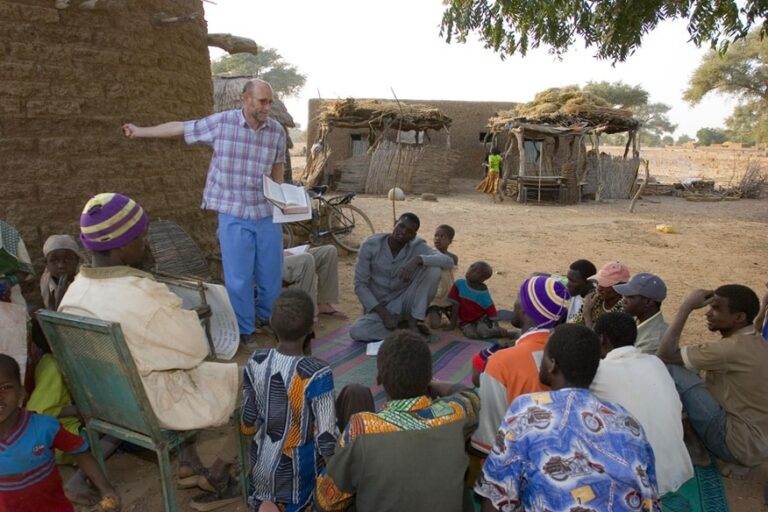
In many parts of Africa church growth is outstripping leadership. Since that is the case, how are these leaders to be trained and how do we recruit for training? Can our schools and training programs help meet church leadership needs? Needs seem to abound around us, but to understand correctly the needs of our constituent churches, we must research our churches to determine their strengths and weaknesses, and hence their needs. Research can be done by surveys, interviews, and/or observations.
The next step is to define clearly the purpose of the school program in terms of the church needs. What kind of workers are required to accomplish this purpose? What does the worker need to be (in attitudes and character); to do (such as be skilled in communication, counseling); and to know (biblical knowledge and other knowledge)? When it is known what the graduate or product must be, do, and know, then the following formula can be used: (1) qualities required; (2) qualities at entrance to school/program; (3) learning needed.
The general objective is then to provide the training needed to raise the one being trained from where he is now to where he should be to do the work required. The next step is to define, in measurable objectives, what the graduate is to know, be and do- an example of which might include: "A successful graduate is an elder who is discipling six others who will be able to disciple others."
A partial list of characteristics for an effective leader of a small congregation might be as follows:
KNOW
Knowledge of scripture
Knowledge of people
Knowledge of church policy
BE
Loving
Diligent
Enthusiastic
Socially at ease
Cooperative
Concerned for the lost
Example in home
Sensitive to Holy Spirit
Sensitive to people’s needs
DO
Communicate Bible truth
Disciple others
Traditionally, learning has concentrated on knowing, with doing, or skill development, as a second priority. However, to be an effective leader of a small congregation, many more characteristics for being are required than for knowing or doing. The being aspect of learning is the hardest part of learning to influence, but as educators, we concentrate on it least. Jesus taught being by living as a model with the disciples. He emphasized being and doing in the Beatitudes and sought to change attitudes, to teach when he ate with sinners and publicans, and when he washed people’s feet. A more conscious attention in curriculum planning and interpersonal contacts and relationships should be given to the being aspect of learning.
Next, we must consider what learning is and the need for a successful field training program. Learning is a relatively permanent change in behavior as a result of experience. The basic ingredients for a successful field training program are as follows.
(1) Student assignment should be close to real-life situations; (2) Need for debriefing: analyzing and evaluation; (3) Planned failures could be part of the teaching situation; (4) Field training does not all need to take place away from the classroom.
The levels of learning in a secular learning philosophy are different from those in God’s plan:
SECULAR
1. Rote (repetition)
2. Recognition (multiple choice)
3. Restatement (can write paragraph)
4. Relates (What does ti mean to me)
5. Response (acts on knowledge)
SCRIPTURAL
Col. 1:9, 10
The Holy Spirit is missing in the secular learning levels. Teaching is creating an environment in which students learn. The student is active, not passive. The learning process is "the change in character required to modify the student from what he is to what he ought to be."
Curriculum, the sum total of learning experience that must be planned to help the learner reach specific objectives, must be considered next. This should include student interaction in a residential school, field work, etc., and not be just class/study requirements. Influences that form the school curriculum are:
Two methods may be used to evaluate how well the learning process is working: A normative approach comparing students to one another by examination, and/or a criteria or competency approach based on a student’s success in relationship to objectives. Leadership skills are lagging behind church growth because of (1) An over-reliance on professional clergy; (2) An over-reliance on residential seminaries; (3) The cultural explanation of relying on imported norms and methods.
Theological education is important because, as we read in Ephesians 4:11, 12, it was Christ who gave some to be apostles, some to be prophets, some to be evangelists, and some to be pastors and teachers-to prepare God’s people for works of service, so that the Body of Christ may be built up. The number one need in African churches today is leadership training in the Word of God. The Lord Jesus’ main ministry was atonement, but his next most important ministry was the training of men. Can our goal be anything less-especially when he tells us, "As you go, make disciples"?
—–
Copyright © 1981 Evangelism and Missions Information Service (EMIS). All rights reserved. Not to be reproduced or copied in any form without written permission from EMIS.