by William McE. Miller, Stephen J. Akangbe, Samuel Od
THE MUSLIM WORLD The region being considered is both geographically and religiously near the heart of the Muslim world. It embraces, however, a number of different nations, races and varieties of religion and culture, so that it is impossible to make statements regarding the work of missionaries from the West that would be true in every situation.
THE MUSLIM WORLD
The region being considered is both geographically and religiously near the heart of the Muslim world. It embraces, however, a number of different nations, races and varieties of religion and culture, so that it is impossible to make statements regarding the work of missionaries from the West that would be true in every situation.
In some, but not all, of these lands, there are ancient Christian churches, the histories of which go back more than 1500 years. Though they were surrounded and ruled over by Muslims for many centuries, these Christians were not overwhelmed or absorbed by Islam. However, because of their precarious position they usually made no effort to evangelize their Muslim and Jewish neighbors. Some of these lands in more recent times became colonies or mandates of Western nations, and in some instances many Europeans came to reside in them. For them Western-type churches were established, but usually the Christians from the West did not assist the native churches, or attempt to convert the non-Christians.
The first Protestant missions from the West were established in the Middle East early in the nineteenth century. The missionaries were seeking to obey Christ's command to make disciples of all nations. It was their hope that the Christian Armenians, Assyrians, Copts, Orthodox and members of the other ancient churches would, when instructed in the Bible and given new life by the Holy Spirit, become God's instrument for evangelizing all the peoples of Asia. Accordingly, they devoted themselves to the task of reviving the Christian minorities. It was not their purpose to divide these communities and create Protestant churches, but this was what happened. Those who accepted the evangelical teaching were often pushed out of the old churches, which on the whole resisted renewal, and they had no choice except to form the "evangelical" churches that exist in Turkey, Lebanon, Syria, Iraq, Egypt and elsewhere today.
Foreign missionaries continued to assist these small churches (which in several countries became large ones) by establishing schools and colleges for their young people, training their pastors, teachers and doctors, and keeping before the members their responsibility for making Christ known to the non-Christians. Some of these Christians became zealous and courageous evangelists to Jews and Muslims. But for the majority the walls of language, custom, belief, prejudice and fear that had existed for more than a thousand years were too high to scale, and too ponderous to move. Too often the "evangelical" churches did little more than the ancient churches had done to "seek and save the lost."
Because of the failure of the national Christians to evangelize, the foreign missionaries began to devote more of their time and effort to direct work for the non-Christians. They treated their sick in the mission hospitals; they educated their young people in the schools in which there were often more Muslims and Jews than Christians; they prepared and distributed Christian literature in the languages spoken by the Muslims; they carried on various kinds of social services, for the purpose of making the truth and love of Christ known both by deed and by word. Also, as the situation permitted, they made evangelistic journeys to towns and villages, and sometimes they were able to assist churches in conducting evangelistic services at which non-Christians were present, and to prepare converts for church membership.
Much of their evangelistic work, and the most effective part of it, was done in personal and friendly contacts with individuals. Wherever possible these efforts were related more or less closely to the evangelical churches, where any existed, though in some instances the churches resented the efforts of missionaries to convert Muslims and bring them into the membership of the church. However, in no land as the result of these efforts was the number of converts large. Today most of the members of the Protestant churches in the Middle East are from the ancient Christian races. The same is true of the Roman Catholic churches.
In recent years the situation in most of these countries has radically changed. There has been an upsurge of nationalism. In many of these lands Islam has been revived as an agent for developing national unity and strength. Foreign control and influence has been rejected or limited in various ways. In some countries the educational and medical institutions of the foreign missions have been taken over by, or largely controlled by, the national governments. In other places some of these institutions are being carried on by the national churches, with or without assistance from missionaries. In at least three of the countries the governments are now encouraging Western Christians to establish and administer important medical and educational projects. On the other hand, from several countries some or all of the Western missionaries have recently been expelled for political reasons. And to two of these lands no foreign missionaries have been admitted in modern times. These are lands in which the ancient churches do not exist. In the countries where Western missionaries are now residing, the problem of securing visas and residence permits is always present, and often becomes acute because of the political crises which frequently occur.
In view of all these things, what is the role of the Western missionary today in his relation to the churches, both old and new, in the Middle East? In some cases he may become a member of one of these churches, and perform his service as a pastor, evangelist, teacher, doctor, nurse, writer, etc., in and through the church, much as a national Christian would do. When the foreign worker has learned the language well, and won the confidence of the church, he will be able to render valuable service in teaching the gospel, in strengthening the evangelistic outreach o f the church, in bringing guidance and encouragement to his brethren in the church, as well as in serving in the medical and educational institutions conducted by the church.
In other situations the missionary, while not a part of the ecclesiastical structure, is able to carry on his work in cooperation with the church, whether it be "evangelical" or "ancient." He may be invited to teach in a church school or seminary, and to assist in conferences or camps. In all countries there is urgent need for the preparation and distribution of up-to-date literature for both Christians and non-Christians, and qualified missionaries may share in this task. In some countries the opportunity for teaching the Bible through correspondence courses is very great. For example, one mission has during the past eight years distributed some 118,000 courses in North Africa alone. Missionaries are needed to help in carrying on this work. They are also needed in the radio ministry, which is becoming more and more important throughout the Middle East.
There is in most lands the need and opportunity for the promotion of literacy, in cooperation with both churches and governments. Missionaries may also play an important role in bringing closer together the many different churches and groups. They can become a vital link between the national Christians, who are often isolated from the Church universal, and their brethren in other parts of the world.
When William Carey went to India at the end of the eighteenth century he was forbidden to reside there as a missionary. So he became an indigo planter and a teacher in a secular institution, and thus supported himself and his colleagues, and became one of the great founders of the Christian movement in Asia. Today in some places in the Middle East it is becoming necessary for Christian workers from other lands to follow Carey's example and find secular positions that will provide financial support, and also an opportunity for them to reside and serve Christ in areas closed to "missionaries."
In some countries Christian medical personnel are today being employed in government hospitals and medical schools, and educationalists are teaching in government and private colleges, or are giving private lessons in the English language to the many young people eager to perfect their English. It is reported that there is a man who is learning masonry in order to be able to reside in a country from which missionaries are being expelled. There are doubtless many positions in government, business and industry in the Middle East that are open to well-trained men and women from the West. Christians should take advantage of this opportunity to reside and share in Christ's work in these lands, in some parts of which no Christian church now exists. There is no place where a Christian whose heart is full of the love. of Christ cannot influence others by friendship and prayer to follow his Master. Some of the "closed lands" are now in this way being opened to the gospel.
It is possible that in the providence of God the role of Western Christians in the evangelization of the Middle East will in the future be a decreasing one, and that he will give to missionaries from the Middle and Far East the privilege and responsibility of continuing and completing a task that has a yet been barely begun. However, as long as the door remains even partially open, we in the West must continue in faith, by every possible means and in the power of the Holy Spirit, the undertaking to which God called our fathers, namely, that of making Christ known to the people in the heartlands of the Islam.
— William McElwee Miller, Missionary of the Presbyterian Church in Iran, 1919-1962.
AFRICA
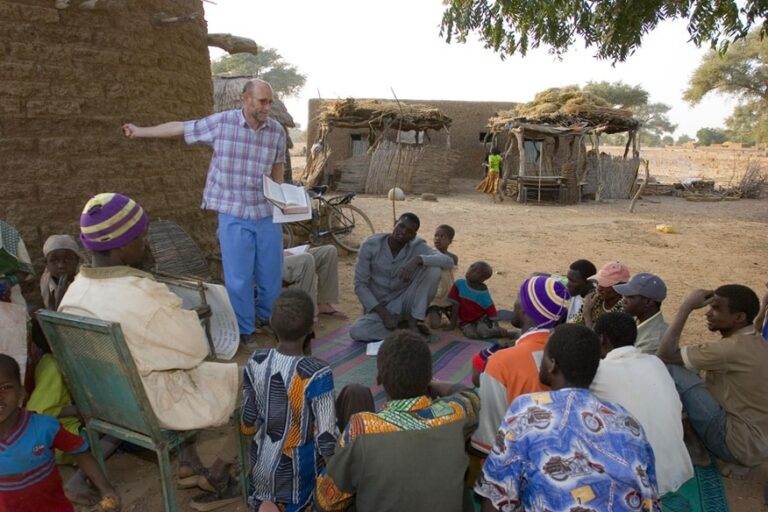
Since the day missionaries started to come to Africa, tremendous achievements have been made by their operations all over the continent. Numerous people have been won to Christ and trained for the Lord's service, either locally or nationally, and many churches have been established. Out of these churches have come individuals who are capable of rural and urban area evangelism. But the continent is so wide and needy that more evangelists are needed. Therefore, Western missionary societies should send more missionaries to train more nationals to preach the gospel and assist in other fields of Christian ministry.
Many nationals could become leaders if they had more training, but they are handicapped simply because of the lack of sound theological institutions and Christian schools. Western missionary societies could be of much blessing in the training of men and women who could adequately take their places in the greater Africa of tomorrow.
Training that cannot be obtained in Africa may be obtained in other countries, if funds are made available by the sending churches with the aid of the mission societies. Training of key people to take missionary posts is the major concern of governments today. Nationalization of posts is also the need and wish of the countries today.Missionaries can be used to make available Christian literature on various levels for the hungry masses of people who like to read. There is a great ministry for literature in Nigeria today. Other secular and false cult publications are being sold almost everywhere on African streets. There is a great danger ahead of us if Christianity lags behind or fails to produce good Christian literature for the public to use.
There is also the ministry of the Word on the radio. These are the days when hundreds of people listen constantly to radio talks. Christian programs come now and then on the air, but there are not enough of them. There should be more support for the establishment of radio ministry in Nigeria.
As to organizational relationship, it is necessary that mission societies should be willing to identify themselves with the organized churches. Some do this by total identification and mixing together with the national Christian churches. These groups have every privilege that individual nationals have, but there are the other groups which feel they may lose their home church membership, so they cannot be full members of two churches at the same time. So they keep their membership with their homeland churches that send them to the mission field. However, whether the missionaries become full members, or associate members, the most important factor is that the missionary should love the national churches and show much interest in the church activities and support her programs. It is the missionary's interest that counts most.. As mission and church organizations there should be one common aim in administration, support and the propagation of the gospel. Mission and church organizations should now be operating as collaborators in the Lord's vineyard.
Since this is a transition period in Africa, missionaries should be prepared to work under nationals, or as a subordinate to some less literate workers. The days of fear and feelings of inferiority are gradually passing away. If the mission and national church are to achieve anything, both should plan to work together. There are nationals who are much more experienced than foreign missionaires. Therefore, race and culture should not prevent a missionary from taking orders from his superior. National workers and pastors must seek the cooperation of the foreign missionaries. No program of the church should be conducted without the invitation and cooperation of the local missionaries.
The overseas or sending churches must bear in mind that general missionaries are still needed. Well-trained personnel will help in propagating the work and contributing to the building up of the nation. Sending churches need to encourage graduates, specially qualified individuals, and support them if they are called to serve in Africa. We need them, we have much use for them. But sending churches will help us more if they help nationals with their support, in order to produce men and women who will fill in for missionaries.
Missionaries are advised to adapt themselves to the culture of their area and not to condemn traditional practices outright. One of the greatest needs of churches in Africa today is mass evangelism. Following this is the need for sound teaching of the Scriptures to fortify the Christians against the waves of Communism, false cults, and pagan teachings. Finance is one of the major needs in Africa. Poverty is still striking many individuals and countries. This is a handicap for the quick growth of the church. Where there is the possibility of helping nationals to tap the natural resources of their land in order to make money for the support of family, community and the Lord's work, this should be encouraged greatly. Total dependence on foreign assistance will not help as much as to be able to obtain this from one's own land.
There is the great need for evangelical bodies to unite. There has been separation and self-centeredness because of some differences in practice and worship that do not affect the fundamental doctrines of Christianity. There are criticisms from the outside and within that we are narrow-minded churches. It is time therefore for mission societies to support strongly the unity of evangelical bodies in Africa for the purpose of fostering the cause of Christianity in these last days. We need to mobilize our resources in order to survive and subdue the raging forces of the evil one.
— Rev. Stephen J. Akangbe, President of the Evangelical Churches of West Africa (1,400 churches, 400,000 adherents) in Nigeria.
An interview with Rev. Samuel Odunaike, President of the Association of Evangelicals of Africa and Madagascar. Mr. Odunaike is Industrial Relations Officer for B. P. Nigeria, Ltd., Lagos, Nigeria. He was interviewed by W. H. Fuller.
Q: What do you feel should be the future role of western missionary societies in regard to national churches in Africa?
A: In general, where churches have been established, I feel that churches will still very much value specialist services by missionaries for the next ten years. These will be necessary in such specialized fields as radio, training institutions, at certain levels, and evangelists with a definite ministry.
Q:What do you feel should be the organizational relationship of mission societies to national churches?
A: I have always felt that a missionary should become a member of the local church just like any other person. The missionary is basically a human being, a Christian, needing the fellowship of other Christians, and spiritual deepening which corporate fellowship provides. The discipline of being a church member is also good for the flesh. I feel this is the only right relationship for a missionary to the local church.
As far as organizational relationship is concerned between a mission society and the church, the ideal would be a submerging of mission and church. However, the ideal is not always feasible. Where missions confine themselves to specialist services as suggested, organizational problems are not likely to be as acute as at the moment, when some missionaries are actually carrying on church functions.
Q:What steps should be taken to fulfill these roles for the future?
A:There should be a decided move to phase out organizational control of churches by missions. The practice whereby missionaries still perform pastoral role in churches (notably in East Africa) should be progressively abandoned. There should be reorientation of missionary outlook by missions (old and new). Bible schools in Africa should include in their curriculum something on "the new dimension" of missions for the new generation. National churches should be reoriented in their outlook to see the evangelization of Africa as their primary responsibility, with missions lending a helping hand.
Q:What are the greatest needs of the churches in Africa?
A:I would list these in the following order: teaching in the Scriptures (with the resultant spiritual depth), evangelism, organization, finance, oneness with evangelicals elsewhere. One could be tempted to place finance higher on the scale, but I firmly believe that with sound biblical teaching, producing spiritual depth, finance will cease to be the perennial headache it is at the moment. I have never seen a New Testament church in want of the finance it needs to do God's work.
INDIA
A. Since the attitude of the government is one of restricting the coming of "missionaries," the attitude of the western missionary societies should be more elastic and changeable regarding the structured definition of the term "missionary." The following suggestions come to mind:
1. The missionary personnel. The established concept that the missionary must be an ordained, and hence an established member of the ecclesiastical hierarchy, need not be true anymore. This concept was never true to the New Testament principles. The missionary of the future in India will be a lay person, with a deep sense of community with the church of Jesus Christ that exists as a witnessing-worshipping community not only in his home country but also in every country of the world. He will not witness in spite of his work, but he will witness within his total life, which definitely includes his daily work. He may enter India as an expert representing a collaborating firm from a non-Indian nation (here, a Western country) to work with the collaborating firm that is Indian. He may come as a Peace Corps volunteer, knowing that he will share the life of the needy who need his know-how and his Christ. He may enter as an exchange scholar to live and work in an Indian university under a local or central government-sponsored scholarship in India.
The task of the Western missionary society will be to find such people and such opportunities, and to bring them together. The financial "burden" then will not be so much theirs. By the same token they may not be able to exercise unnecessary, sometimes irrelevant, authority over "their missionary." Technically qualified men like doctors, engineers, and teachers may band together and choose one spot in India under the guidance of the Holy Spirit, through the functioning usefulness of the Western missionary societies and their knowledge of mission needs. They then can divide the work on the "station" among themselves, so that no one member will have to stay in India more than two or three months at a time. This plan will eliminate the red-tape and will allow each specialist to make his own living while he resides in the Western country for the rest of the year. At the same time, the "station" will be occupied throughout the year. The help and advice and continued counsel of the Indian churches is absolutely essential in this effort.
2. The duration of a term. This must be extremely flexible. This will be determined by the need of the specific type of entry permit. Short terms will be more and more workable and effective. This will help bring in new vitality from the home country to the Indian church, and from the Indian church to the home country.
3. National church-missionary relationship. This will no longer be one-sided. The lay missionary needs the national church as much as any Christian needs it. He is part of it and not a mere professional adviser. The national church needs him as she needs all other believers as her agency of expression.
B. The Western missionary societies must be colearners with the national church as Christ continues to speak to both of them as one, i.e., his church in the Indian situation. There should be a partnership in obedience to the commission of Christ in this Indian situation, rather than to the dictates of men who may be tempted to safeguard the structure that gives them a present identity instead of the fulfilment of the purpose for which that structure was brought into existence. In this obedience there should be little thought of separating resources in time, talent or treasure in terms of "Indian" and "non-Indian." The response should be in terms of an organic wholeness rather than organizational calculations. When the church in India is pinched, the church in the U.S.A. or Canada must spontaneously cry, "Ouch, that hurts!" and vice-versa.
Such a oneness in obedience will be timely, will be relevant, and may demand types of action that may be considered too revolutionary in the understanding of the Western society. (Although under the present circumstances, I doubt if this will be true!). The church must once again begin to give the answers. She must scratch where the Indian society itches. Otherwise, she will be an agent of irritation rather than healing.
C. The entire pattern that has been described thus far demands that the Western missionary societies lose themselves in the concern to fulfill the task of the church in India. They must be willing to transcend the denominational hang-ups. They should not be interested in fighting their theological wars on a foreign soil any more. We have had enough of that. The mood of the national church in India is one of regrouping for evangelical action: one Lord, one purpose, one kingdom.
— Rev. Samuel Kamaleson, Pastor, Emmanuel Methodist Church, Madras, India.
ASIA
1. Where a church is strong, the missionary societies from the West should withdraw all their personnel from the field. Only specialist workers such as those engaged in theological training and Bible teaching might be asked by the national church to remain.
2. Every effort must be made to train Asians for positions of leadership in the church. This will mean full freedom on the part of missionaries to allow Asian Christians to express their witness to Jesus Christ in the cultural pattern of their country and to restructure their church in a way that is practical to the national setting.
3. Finance on the field should not be in the hands of missions, especially if this relates to grants to national pastors' salaries, church projects and institutions. Asian Christians should be challenged to be self-supporting and contributing to the building of God's church on other continents. We become equals when we have the responsibility of giving to others.
4. Key Asian leaders could be sent abroad for training in post-graduate theological courses so that they could return to their countries to teach as theologians. Others might be sent for communications courses.
— Chua Wee Hian, Associate General Secretary, International Fellowship of Evangelical Students, Singapore.
—–
Copyright © 1971 Evangelism and Missions Information Service (EMIS). All rights reserved. Not to be reproduced or copied in any form without written permission from EMIS.