by Robert McMahon
Three quarters of a century separate us from the first, brash student volunteers who planned “the evangelization of the world in this generation.” Mott, Donald Fraser, Temple Gairdner and many more—there are still some in the Scottish Church who can remember the great names and the spirit of their times.
Three quarters of a century separate us from the first, brash student volunteers who planned "the evangelization of the world in this generation." Mott, Donald Fraser, Temple Gairdner and many more-there are still some in the Scottish Church who can remember the great names and the spirit of their times.
It was a spirit that did not merely steam up at places like Keswick Convention and D. L. Moody’s student camps, although it often began there; it survived the rude realities of missionary life, swotting Arabic or Swahili in the hot afternoon, measuring out rice for orphans, paying the catechists, beating down the banias, building schools and giving out tracts, and often, it seems from the gravestones, making children’s coffins.
You can see, even now, the brick memorials to that pioneering age in a thousand and one mission institutions. I think for example, of the school that John McNeel built on swampland in Seoni, India; of his cycle ride to Nagpur and, rightabout-turn, to Jabalpur to ferret out the Government commissioner and get educational grants-260 miles, his whole journey.
Without for a moment wanting to put the clock back to Victorian, imperialistic ways of thinking; without saying that everything about the old topee-ed, missionary sahibs was angelic, or that Saint Paul would necessarily have chosen to put up his mosquito net in one of their compounds; without, that is, shutting our eyes or forgetting where we are in 1965, we must feel that Something, which they had, has been drained out of the church today.
What lay behind the zestful missionary slogans of Queen Victoria’s day? Answer: deep, deep spiritual experiences. Like Donald Fraser’s in a tent at Keswick, "weeping like a fool . . . under an awful sense of my sin of unbelief, and dedicating myself to God, accepting the wonder of the Trinity, and receiving the blessed Guest Himself into my life." Out of the warm, evangelical experience, out of spiritual revivals, out of prayer meetings sprang the great missionary movements. And, perhaps not curiously, each great spiritual movement has been followed by the opening of locked doors to the church’s missionaries-just as, conversely, spiritual decline in the West is now followed by the slamming of doors to opportunity and, to take our own case, the steady decline in the missionary force.
SORELY PRACTICAL
Now all this seems sorely practical. It means that, if we sense Something is missing in the present situation-and how many at General Assembly applauded and presumably approved a young missionary from Nyasaland who bewailed the absence of spirit, or of the Spirit, from current foreign mission deliberations-and if we agree that this Something was once in the kirk in irrepressible force, then we must recapture the old secret instead of merely lecturing kirks, telling dead men to look lively and pay tithes. Even to appeal for more missionaries to fill awful gaps is-while itself inescapable-not getting us to the main matter.
We need a thoroughly revived Scottish Church. A deep work of God’s Spirit. Something more, that is, than all the necessary crusades, stewardship campaigns and stimulations.
That seems a truism; but such a movement will, likely, be fought tooth and nail in the Church. It always has been. Wesley, Jonathan Edwards, Whitefield and our own spiritual giants, whose faithfulness ushered in a revival for the church (followed by an era of social reform and missionary expansion), were abused. The missionary pioneers-example, Careymoved against mountainous church opposition.
But there seems in 1965 no less costly way. For this reason, one would like to know of a great volume of private prayer and of the re-birth of prayer meetings, which were once normal in the kirks, cottages and colleges. . . and which, come to think of it, were a mark of that early church which was told to "tarry," mark time, to be clothed with power and fitted out for an otherwise impossible, to-the-ends-of-the-earth task.
ALTERNATIVES TRIED
We have tried most of the alternatives in recent decades. Surely even the evangelicals, whose tradition all this is, who today talk about prayer but do not pray, are humbled enough?
Most of us who are missionaries on furlough this year can think of many unfinished tasks. Things even the first missionaries meant to do, and see to a finish, in that golden age of student volunteers sixty and more years ago.
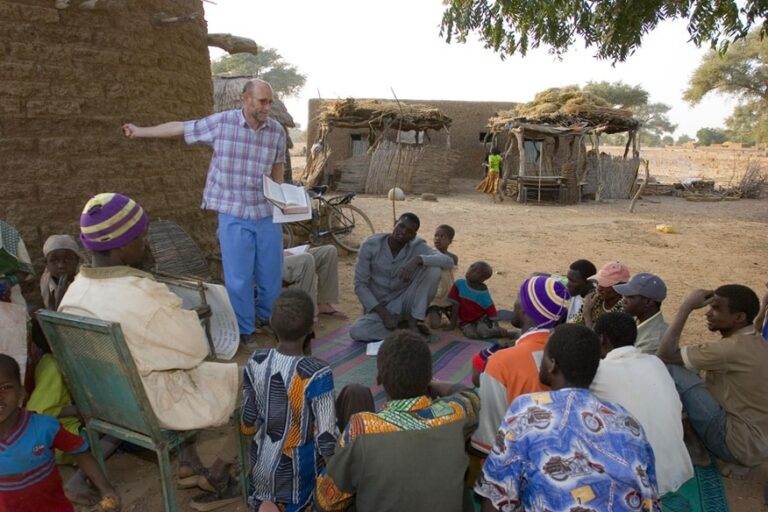
For myself, I think of the tribal Gonds and the other villagers of Central India, who were going to be evangelized in that exuberant age. In fact, in the area I know best, almost no one, Indian, Christian or foreigner, goes near the villagers. No one cares, far less dares.
A kind of ecclesiastical archaeology today could dig up, all over our missionary world, the decayed records of loving labour that used to be done but is not done now by anyone.
To be honest, I suppose very few can claim to care in that genuine, agonized way that, say, Hudson Taylor cared for the millions of China a century ago. We have no responsibility for the Chinese now, we can soothe ourselves; the myriads without Christ in those great, forgotten cities are not, in the same way, our concern, and we can find theologies to bolster this illusion, and prayers to thank God that we are not like those missionary diehards of the day before yesterday.
If we keep to our present paths, we will not be surprised (and some may be relieved) to see, one by one, even our present reduced missionary opportunities stripped by God from our hands.
If, however, we return to the Lord-how else can you phrase it? – in the same way as our fathers returned, we will see a new missionary age beginning. And the world is hardly less needy than once it was.
Reprinted by permission from Life and Work, publication of the Church of Scotland, September, 1964.
EMQ, Vol. 3, No. 3, pp. 10-12. Copyright © 1965 Evangelism and Missions Information Service (EMIS). All rights reserved. Not to be reproduced or copied in any form without written permission from EMIS.